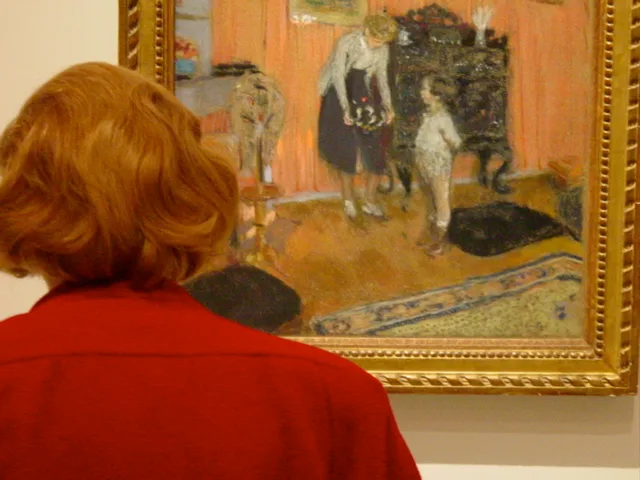
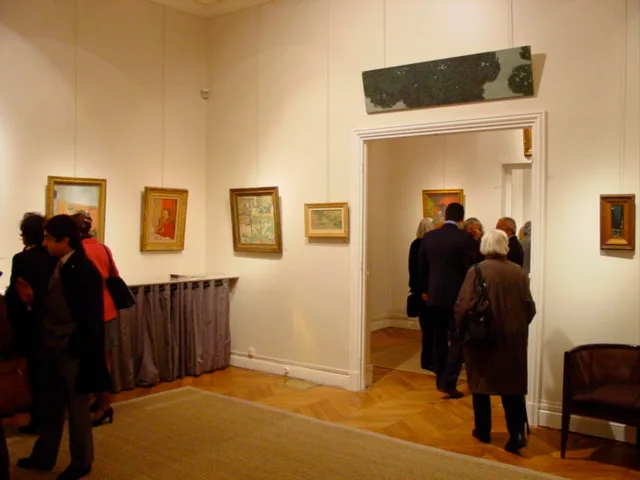
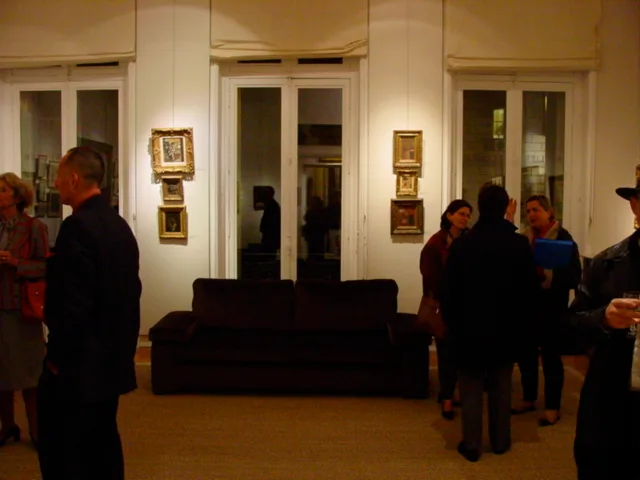
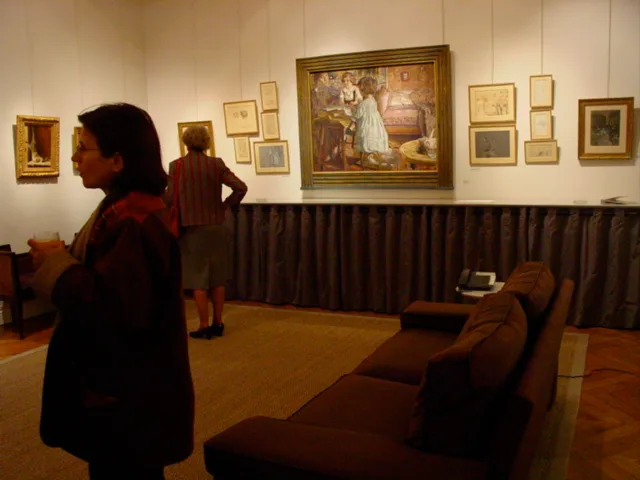
Édouard Vuillard, Le silence me garde
Luc Bellier Gallery — 12 November – 31 December 2002
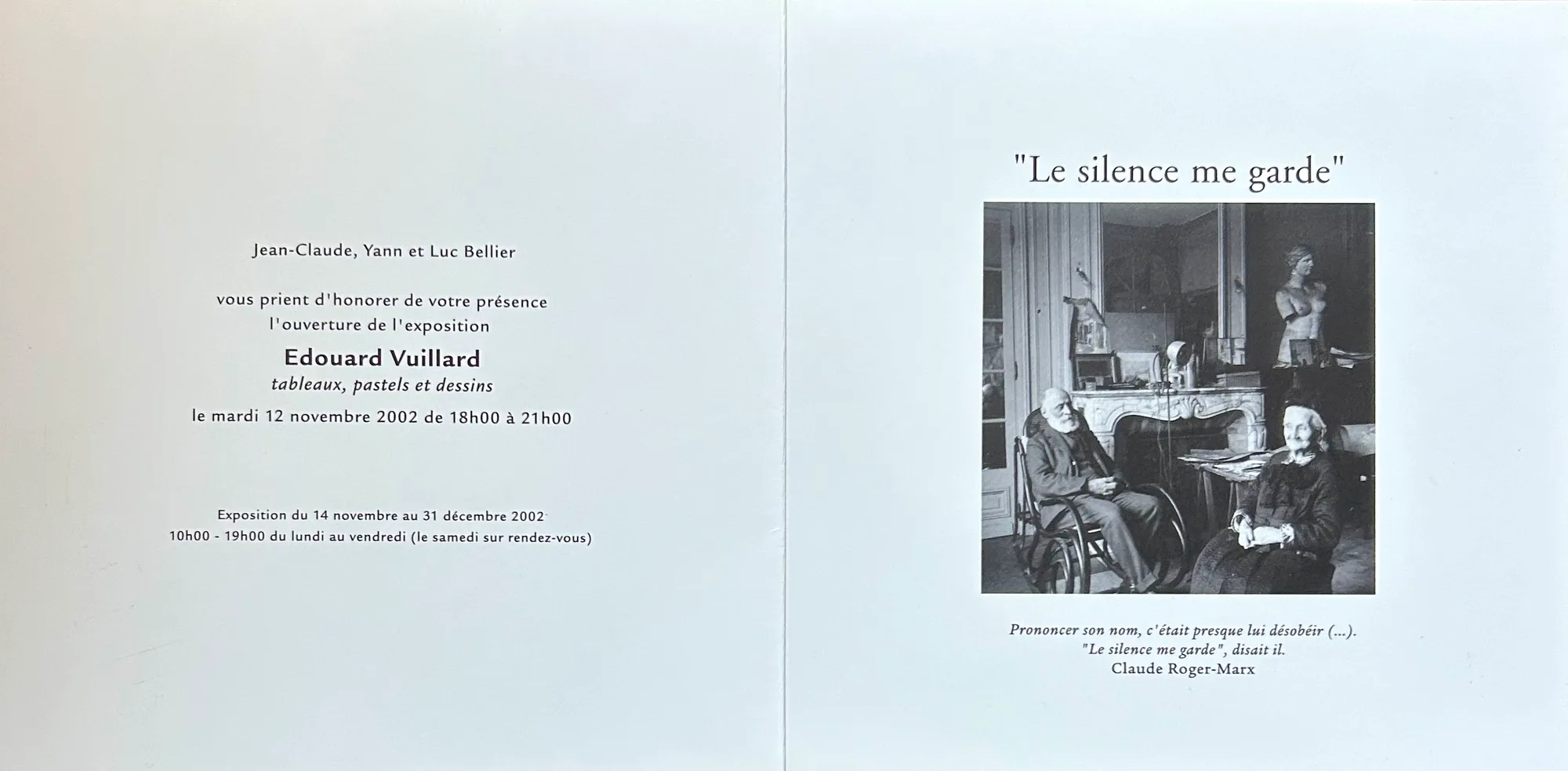
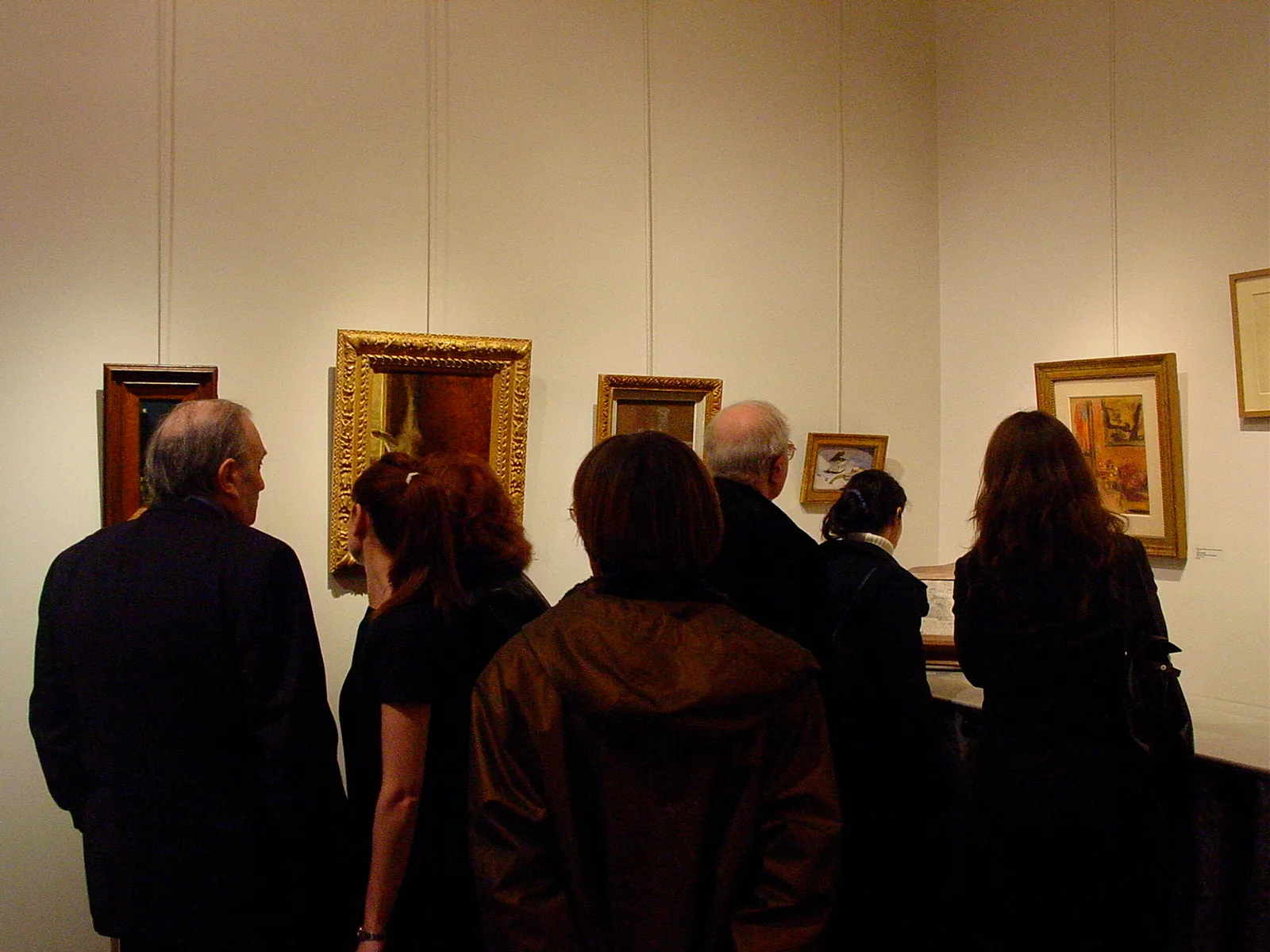
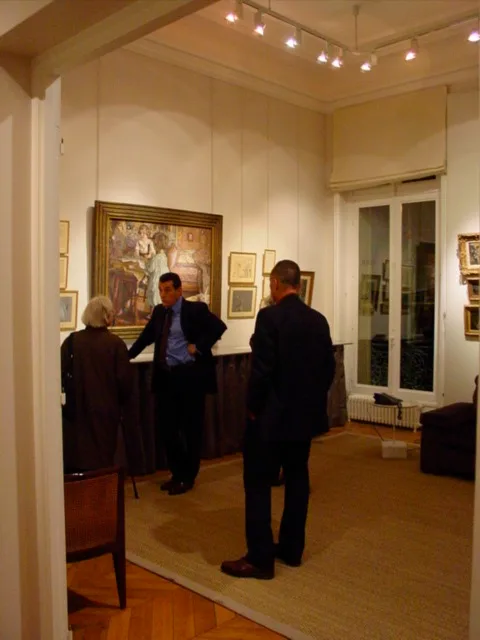
This Vuillard exhibition holds a particular and symbolic importance in several respects: it opens in Paris on the 134th anniversary of the artist's birth; and, with nearly fifty paintings and pastels, it is the largest organised by a gallery since Wildenstein in New York in 1964.
On a private, if not family, level, it embodies a tribute I am happy to be able to pay to my grandfather Alph Bellier, who began the family's activity in the art trade in 1920 and who was close to Vuillard — he had the sad privilege of signing the artist's death certificate at La Baule in 1940. On an artistic level, it is a further opportunity to evoke Vuillard's genius.
In this respect, I would like to draw attention to one point. To try to understand Vuillard, beyond the usual ideas, one needs to know who he was. For this we have a few precious testimonies, beginning with the poetic one of Aurélien Lugné-Poe: “One tasted a smiling peace in Vuillard's company. Nothing was more harmonious than Vuillard's life and gestures, turning to kindness without seeming to seek it, always stepping aside with the most exquisite modesty behind the merits of others, who respected him. He kept to the shadows before casting that richly varied light of his, which came to him along with each of his white hairs”.
It is a fact that Vuillard had the gift of inspiring naturally apt and beautiful sentences in the friends and chroniclers of his work, who took with them a language and a spirit that are now gone. André Gide's comment will not contradict this: “I know few bodies of work in which the conversation with the author is more direct. He speaks in a low voice, as befits a confidence... One leans in to listen to him... too delicate to assert, he insinuates. No striving for effect, a constant need for harmony. Each colour unexpectedly explains its neighbour, and draws from it, and vice versa, a confession.”
Vuillard was a delicate and reserved man, which may have softened the impact of his work. But, as we know, Vuillard has long been considered a very great artist, prized by collectors in his lifetime, and the incredible diversity of his work can be seen in every museum in the world. What other painter, before or after him, achieved anything equivalent to the
Jardins Publics, the Vaquez Panels, or Premiers fruits, which are the complete fulfilment of painting, a perfect fusion of the sensual and the cerebral? In mural and decorative painting he is no doubt the greatest in history and, with the exception of Matisse, whom he notably inspired, and of Bonnard, he is the last representative of this art form. Indeed, a whole world disappeared with Vuillard, whose humanism could not survive the unleashing of Nazi barbarity: a radiant France, which he embodied wonderfully, more brilliant and witty than arrogant; a bourgeois, cosmopolitan society open to the arts, whose last moments and last representatives he conscientiously painted.
Alongside his large formats, Vuillard painted a great many small, even tiny, pictures. They have often been called intimate scenes, which is not wrong but too reductive: while their matt texture is constant, they are otherwise extraordinarily varied, often steeped in a mysterious atmosphere, always sensual, always complex to the point of turning into enigmas.
In truth, Vuillard, whom we think we know, always managed to cover his tracks.
The selection of works gathered here, which spans the artist's entire career, from the early paintings steeped in the art of Chardin, through a panorama of Nabi works, to the large and beautiful compositions of the 20th century, not forgetting the pastels, a field in which Vuillard excelled, will, I hope, give everyone the opportunity to meet the delicate and most noble Monsieur Vuillard.
On Vuillard
Extracts from an interview with Guy Cogeval, director of the Montreal Museum of Fine Arts and author of the catalogue raisonné of Vuillard's work.
L.B : Why does Vuillard have a reputation for being a discreet, reserved, silent man?
G.C : The first, superficial reaction would be to place too much emphasis on his solitude and his shyness; the reality is that he sought the company of others and cultivated friendships passionately. In his Journal, we read that he walked tirelessly around Paris with his friends. From the very beginning, he dreamt of a community of artists and intellectuals that would last forever. This must be remembered if we are to understand properly the meaning of his stays at Valvins or Villeneuve-sur-Yonne, where being surrounded by Thadée and Misia Natanson, Henri de Toulouse-Lautrec, Romain Coolus and Félix Vallotton raised him to a more refined level of artistic ambition.
Vuillard was made entirely of contradictions: he always seemed reserved, but the friends who knew him well, such as Thadée Natanson, went out with him to the Divan Japonais, the Chat Noir, the Tabarin and the Moulin Rouge (where he sometimes found models). It was not unusual for him to come home tipsy at night. He was a true Parisian night owl, a colourful character. There would always be something of the discreet socialite about him.
At the Lycée Condorcet (1879–1885), he chose extrovert friends: Julien Magnin, Henri Colmet d'Aâge, Frédéric Henry, Pierre Veber, Pierre Hermant. Compared with them, he dragged a double inferiority complex behind him like a ball and chain: his physique, which he found hard to accept, and his modest origins.
At the height of his Nabi period, when his paintings were cryptic, living within the group formed by Denis, Bonnard, Ranson, Sérusier, Roussel and Cazalis forced him to open up to the realities of the world. And Condorcet had quietly instilled in him the idea that he should remain attached to an elitist artistic circle.
Naturally, with the Natansons, Vuillard found himself surrounded by the most prominent intellectuals in Paris. Later, in the Hessels' villas (1901–1914), with Coolus, Tristan Bernard, Marthe Mellot and Alfred Natanson, they played cards and lazed on the beach, but even so, in the evenings, they argued over the interpretation of Nietzsche or Pascal's Pensées. In the last twenty years of his life, Vuillard read Sinclair Lewis, Gertrude Stein, Kropotkin, Paul Claudel and Valéry, but also Cervantes, Chateaubriand, Gide, Flaubert... not to mention Baudelaire and Mallarmé. Always! His curiosity was encyclopaedic.
Lucy Hessel and Vuillard went together to every major performance staged in Paris. He never missed a single performance of the Ballets Russes; whenever the Paris Opéra put on a Wagner, he rushed to it. In London, he saw Shakespeare plays in English. He was in the audience on the opening night of Claude Debussy's "danced poem", Le Martyre de Saint Sébastien (1911), which he found "very interesting and gamey". "Gamey" is just the right word for d'Annunzio's text, at once religious and perverse, affected and falsely medieval, "rather a lot" homosexual-chic; and Debussy's music lays it on even thicker.
Vuillard wonderfully embodied a "resolutely French" spirit in what is least irritating about the French: he was the very opposite of the insufferable chauvinist, sure of himself and pleased with his supposed superiority over the rest of the world. But he had a sense of order. He could have proclaimed, like Puvis de Chavannes: “I love order because I passionately love clarity.” Indeed, at the end of his life, he became obsessed with the idea of being the last link in a "French tradition" that began with Poussin, La Hyre and Le Brun and led to Redon, Bonnard and himself.
When Vuillard was in the company of Thadée and Misia, his first motivation was not a desire to seduce the young woman. In reality, he was deeply happy to be surrounded by two friends who understood him and shared his intellectual aspirations. They could exchange ideas, and he needed that all the time. When a painting gave him difficulties, he sought Bonnard's opinion — most often — as well as that of Denis, Roussel and Vallotton. He was the very opposite of a loner.
L.B : Was Vuillard destined to have such a singular artistic career?
G.C : Being part of the Nabi group was very beneficial for him. Can one imagine a group of artists so intellectually curious, and above all advocating that the truth of the arts lies in the most open use of techniques: theatre sets, screens, fans, small paintings, large decorations? A certain definition of modernity begins with the Nabis. In the theatre, with lighting systems, gauze veils and slowed-down diction; it was Vuillard and Lugné-Poe, together with Paul Fort, who invented the transparent metallic gauze screen that separates the actors on stage from the audience. In Henri de Régnier's La Gardienne (1894, sets by Vuillard), a chorus of reciters in the orchestra pit comments on the action on stage: voice, image and gesture are thus dissociated.
All of Vuillard's painting from 1893 to 1894, that much-admired period, bears the mark of his work as a theatre designer, from Le Prétendant and Intérieur au lit rouge to the Grand Intérieur aux six personnages in Zurich, which is its culmination. At that time, Vuillard staged his paintings, set the lighting and the scenery, and used them as "repertoires" of gestures and attitudes.
Vuillard was almost a true stage director, like Lugné-Poe (although he never dared to direct actors). On the other hand, he directed his household and those close to him. He sometimes provoked family disasters in order to paint them. In that sense, he was a real manipulator.
L.B : Is Vuillard the boldest, the most brilliant of the Nabis?
G.C : Yes, and indeed in 1890, when Ranson lent him his studio for several weeks in the summer, Vuillard went through a fundamental moment in which his use of colour became explosive.
His Octagonal Self-Portrait sets him apart, even from the boldest works, with the exception of Van Gogh's at Auvers-sur-Oise. It expresses a rare, obstinate self-assertion (especially for a young man of twenty-two who until then had been influenced by François Flameng, Rixens and Bouguereau!). Within a few months, Vuillard "found himself". He arrived at compositions that were sometimes bolder than Gauguin's of the same period.
There remains an element of mystery in this turnaround, because it has no equivalent; at that time Bonnard was producing interesting works, but before 1900 nothing comparable to what Vuillard was doing. In 1890 he wrote this extraordinary sentence: “Last night I dreamt of a gallery of Italian portraits in cloisonné.” The Octagonal Self-Portrait is Antonello da Messina seen through hallucinogens.
L.B : Was there not also a unique, studious and voracious desire to absorb the artists of previous centuries: Le Sueur and the great French tradition of the 18th century?
G.C : Vuillard was in love with the painters in the Louvre. He needed to absorb the forms of the past. Sometimes, quite astonishingly, he would claim that a painting which, to us, bears no resemblance whatsoever to Le Sueur "works" like a Le Sueur.
Vuillard often wrote in his journal that French art could do without all the Italian "pomp". In 1894 he went to the Musée de Cluny to admire The Lady and the Unicorn tapestry and judged it more beautiful than anything Italian art had produced. Much later, he changed his mind after travelling to Italy several times; in Rome in 1898, and again in 1914, he was utterly captivated. Many of his late compositions were inspired by Guercino (the decoration for the League of Nations in Geneva) and by the great decorative schemes he admired in Venice, Mantua (he adored the Camera degli Sposi) and Florence. But from 1900 onwards, his favourite museum was the Prado.
L.B : At the end of the second chapter of your catalogue, you quote a sentence by André Chastel: “Like Mallarmé, Vuillard reigns over that family of artists for whom the unfolding of the imagination matters less than the exercise of sensibility.”
G.C : Reading the Journal (few specialists have read the years 1920 to 1940: everyone finds them boring, yet they are the most interesting part), I noticed that Vuillard constantly quotes Mallarmé, often without writing his name or using quotation marks. You have to know the poet well to realise that it is Mallarmé.
Vuillard really is the artist closest to the poet of the Faun. When the Englishman Alfred Sutro grew impatient at hearing Vuillard constantly quote Mallarmé, and admitted that he found him obscure, Vuillard replied angrily: “There is nothing to understand, it is all in the rhythm of the sentence!”
What draws Vuillard to Mallarmé's poetry? The feeling that naming things destroys their deeper truth: "to suggest, that is the dream".
L.B : How long did Mallarmé's hold over Vuillard's work last?
G.C : All his life. But Vuillard cannot be reduced to this single influence. Between 1890 and 1900, he was attuned to the spirit of the times, which was the great moment of Symbolist thought. Pushing the point a little, one could say that Vuillard was also Maeterlinckian and, why not, Wagnerian. The idea of the voice melting, like an instrument, into the orchestral fabric is Wagnerian in essence. Wagner's art places us inside the flow of visual and auditory impressions. As soon as the curtain rises, the spectator must feel surrounded by the orchestra and the scenery. Lighting, music, acting and voices intertwine completely and form a single "compact" spectacle. So it is with the Jardins Publics, the Natanson Panels (L'Album) and (above all) the Vaquez Panels: these are decorations that determine our apprehension of space and secrete their own dimensional logic.
In L'Album, this sequence of collages of striped and starred motifs becomes a kind of link of exchange between the "plasma" surrounding the figures and the women, who lose their corporeality and merge into a "whole". This is also why Vuillard so admired the art of Odilon Redon.
Vuillard practises a subtle "infinite melody of timbres": he transposes into painting a dense and continuous orchestral fabric, at once tight and transparent, as is often the case with Debussy. Let us be clear: he did not "frequent" Claude Debussy (although he did meet him at the Revue Blanche), but the correspondences with his music are dazzling, notably with the Debussy of La Damoiselle élue, when Vuillard painted Les Femmes au jardin (1891), his most Pre-Raphaelite work. His development then runs parallel to the composer's: the Schopfer Panels (1898) are like a counterpoint to Debussy's Nocturnes for orchestra.
One cannot create a work like the Natanson Panels without having truly imagined, one day, the absolute suspension of every point of reference. He no longer even has his feet on the ground: La Table de Toilette is illegible, indecipherable at first sight. Personally, I do not know what is happening in it — no doubt because nothing is happening — but I can describe what becomes of the texture. These are perhaps the first "abstract" compositions in history.
L.B : Which brings us to the difficulty one sometimes has in deciphering Vuillard.
G.C : Vuillard quite often reaches that higher degree of the decorative that Mallarmé speaks of. The moment when one is completely detached from any narrative. It is very paradoxical, because he is, moreover, someone who knows admirably how to carry a narrative.
It is of him, and not of Gauguin, that Mallarmé should have said: “so much mystery in so much brilliance” (as Le Prétendant, La Soirée Familiale and La Vie Conjugale bear witness), but it would be more accurate to reverse the proposition: “so much brilliance in so much mystery!” What dominates in Vuillard is his sense of ellipsis, of unease, of the strange, but within it there is sometimes the deafening crash of anger, a kind of metaphysical "hubris". Hubris is the irrepressible anger of the gods in Greek tragedy. Violence in its purest state.
And at the same time, what is wonderful is that Vuillard's painting remains profoundly seductive. He plays with this, and he is not mocking us. He knows very well that his style is enchanting and pleasing, that he is one of the greatest "technicians" of painting: few painters could use glue-based distemper as he does. His painting reaches towards the mysteries of a language, that of Symbolism. He seeks it out, and the encounter is absolutely inevitable. In my writings I have insisted a great deal on his veiled cruelty, on his "dark" side. But let us acknowledge that Vuillard intends above all to paint beautiful works — an idea under attack today, in the name of "painting as crime" and other nonsense that makes the half-educated swoon.
I am delighted that the general public loves Vuillard at first sight. They are right!
L.B : So, right to the end, Vuillard needed this human warmth, and his mind remained sharp and curious.
G.C : Yes, but he lost a number of friends who had been very important interlocutors. For example, around 1900 the person closest to him in friendship and intellect was Vallotton. In 1925, Vuillard learnt of his death by telephone. It was a terrible shock. He was devastated. At that time, he had barely begun the portraits of his friends Maillol and Roussel in the studio. I think it was at that moment that he decided to paint the four Anabaptists, adding Bonnard and Denis, in order to fix their features and ward off death.
Interview between Luc Bellier and Guy Cogeval,
Paris, August 2002.
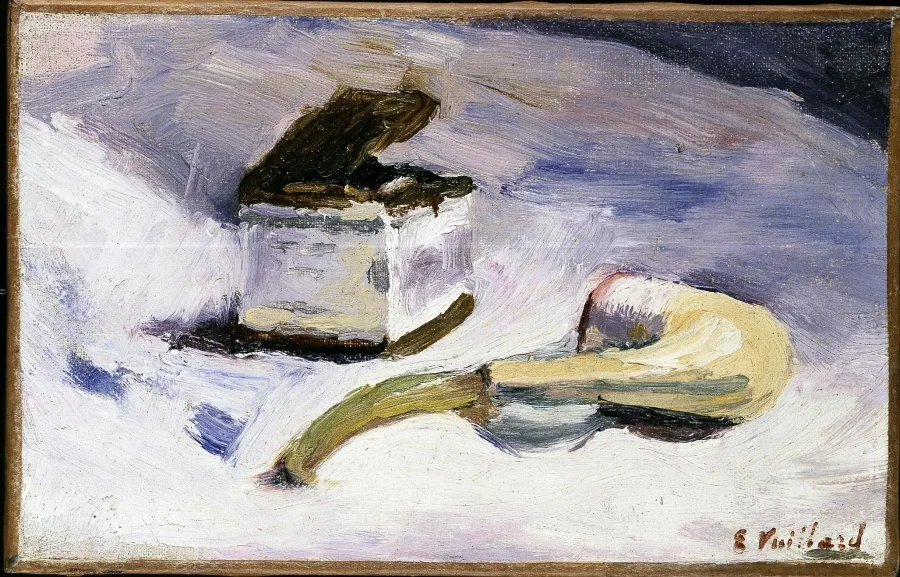
Pipe d'écume et paquet de tabac, c.1888
Oil on canvas, 13 × 21 cm, signature stamp lower right
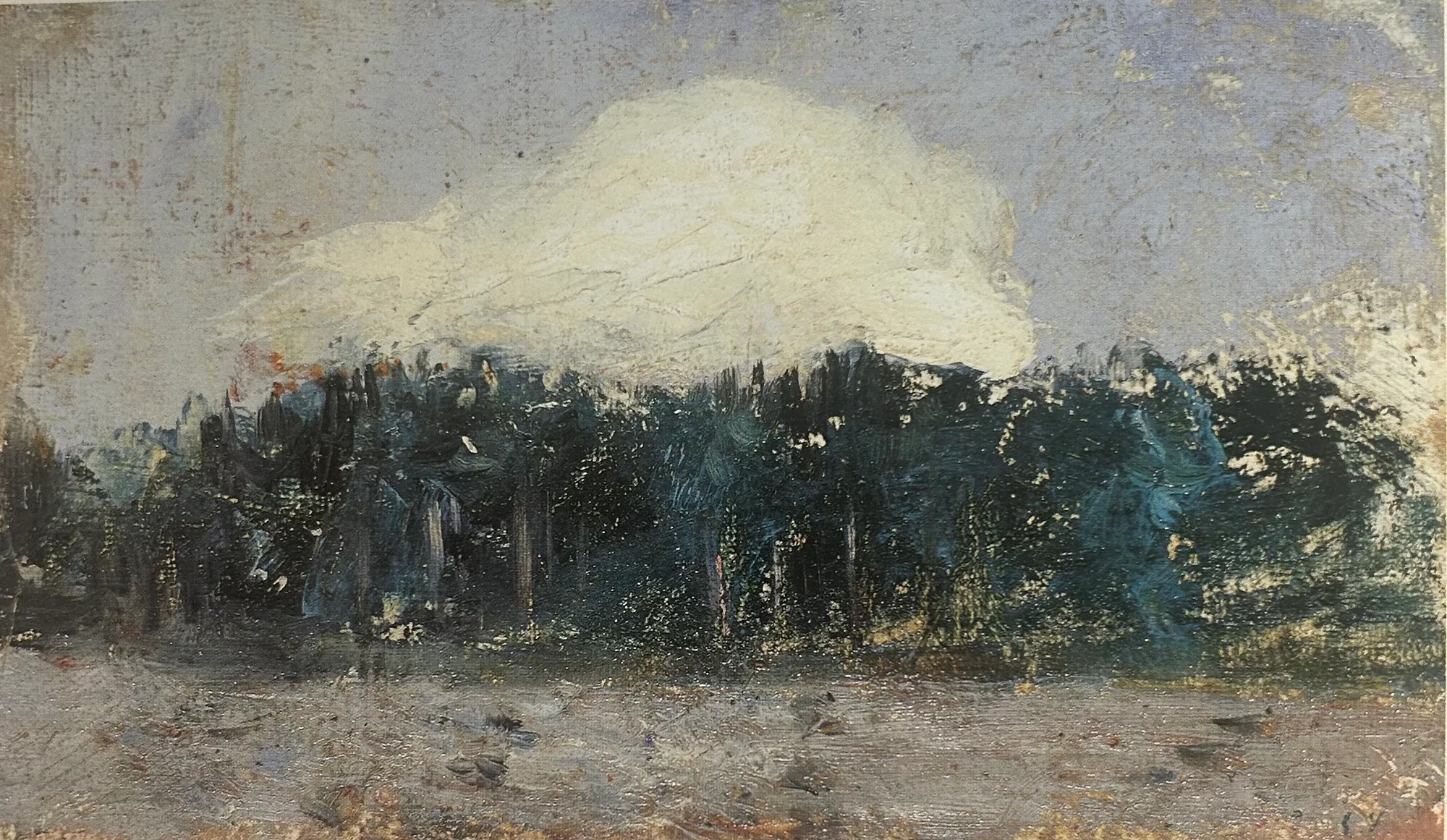
Nuage blanc sur la forêt, 1889
Oil on board laid down on canvas, 12.5 × 21 cm
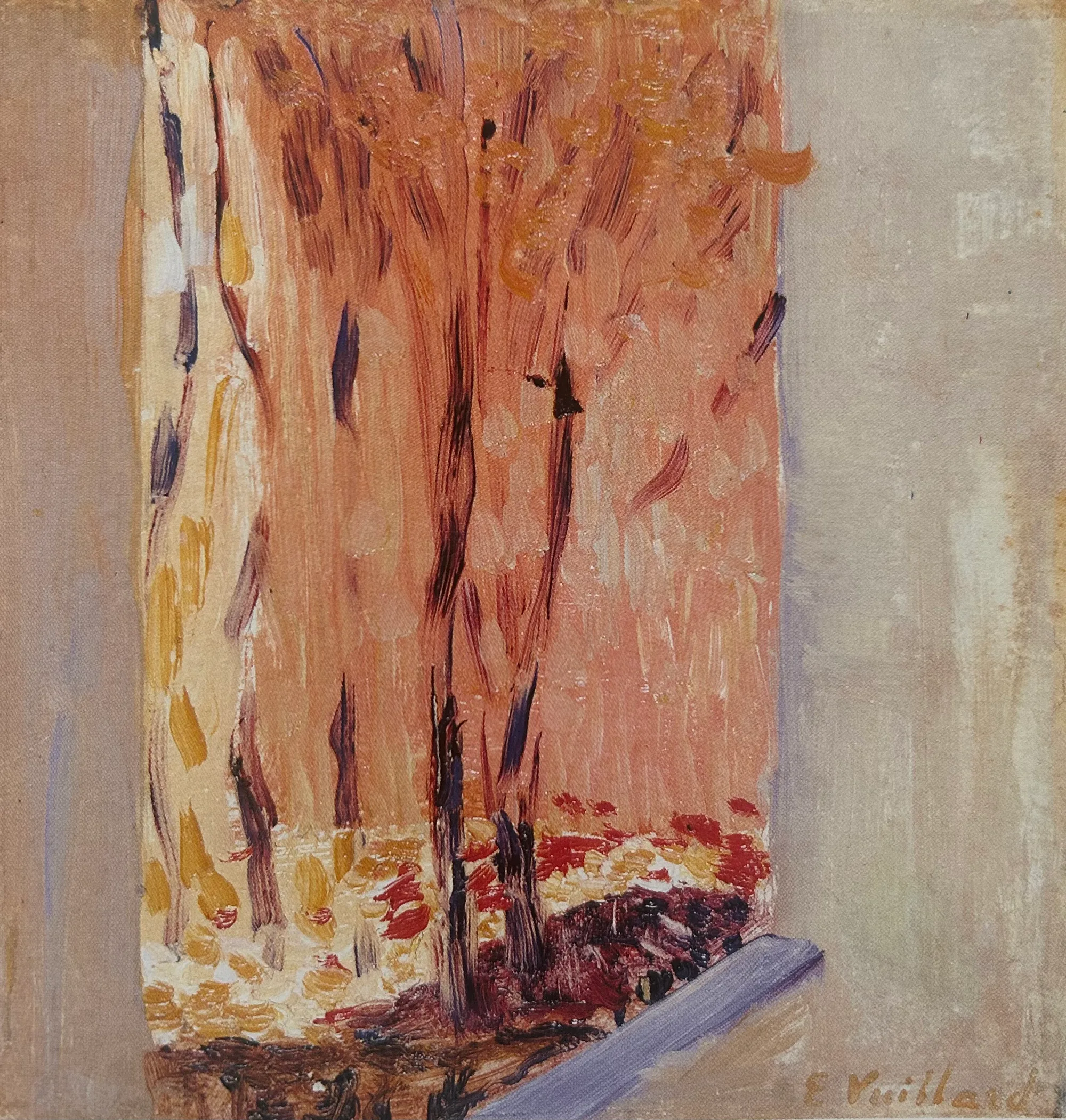
Vue d’une fenêtre, c.1889-1890
Oil on paper laid down on board, 14.6 × 13.8 cm
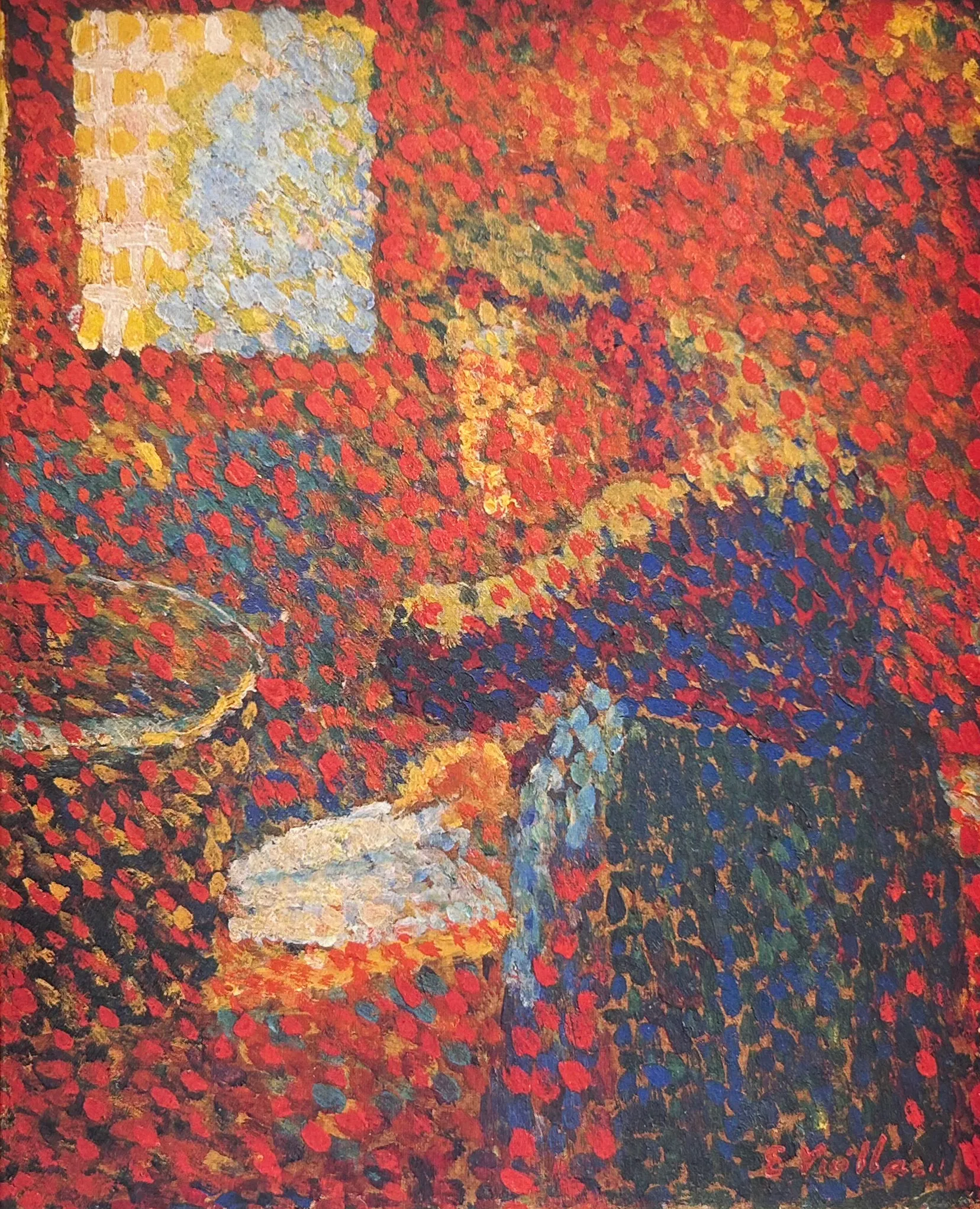
La grand-mère à l'évier, c.1890
Oil on board, laid down on a cradled panel, 22.5 × 18.3 cm, studio stamp lower right
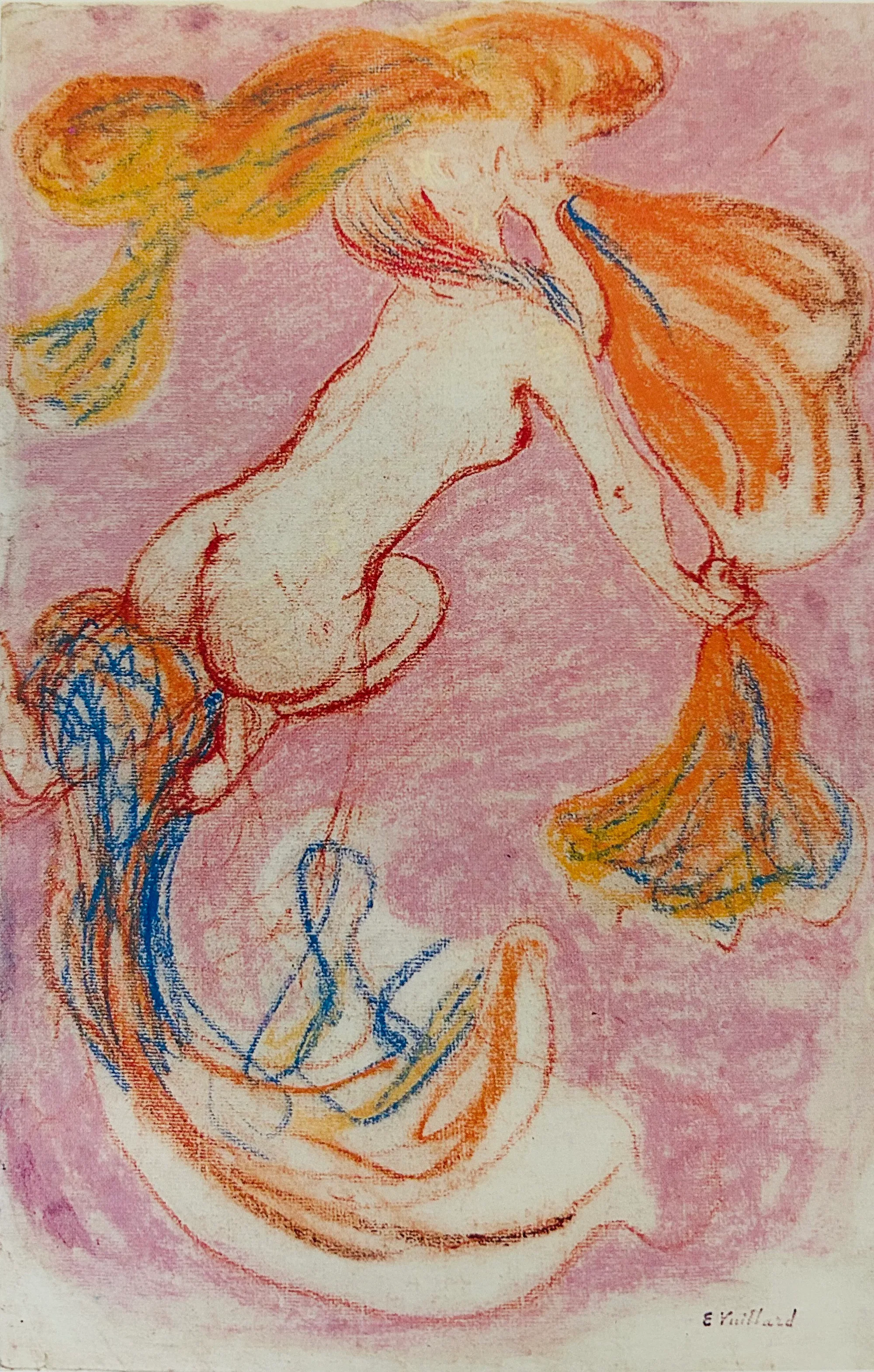
Naïade, c.1891
Pastel on paper, 47 × 31 cm
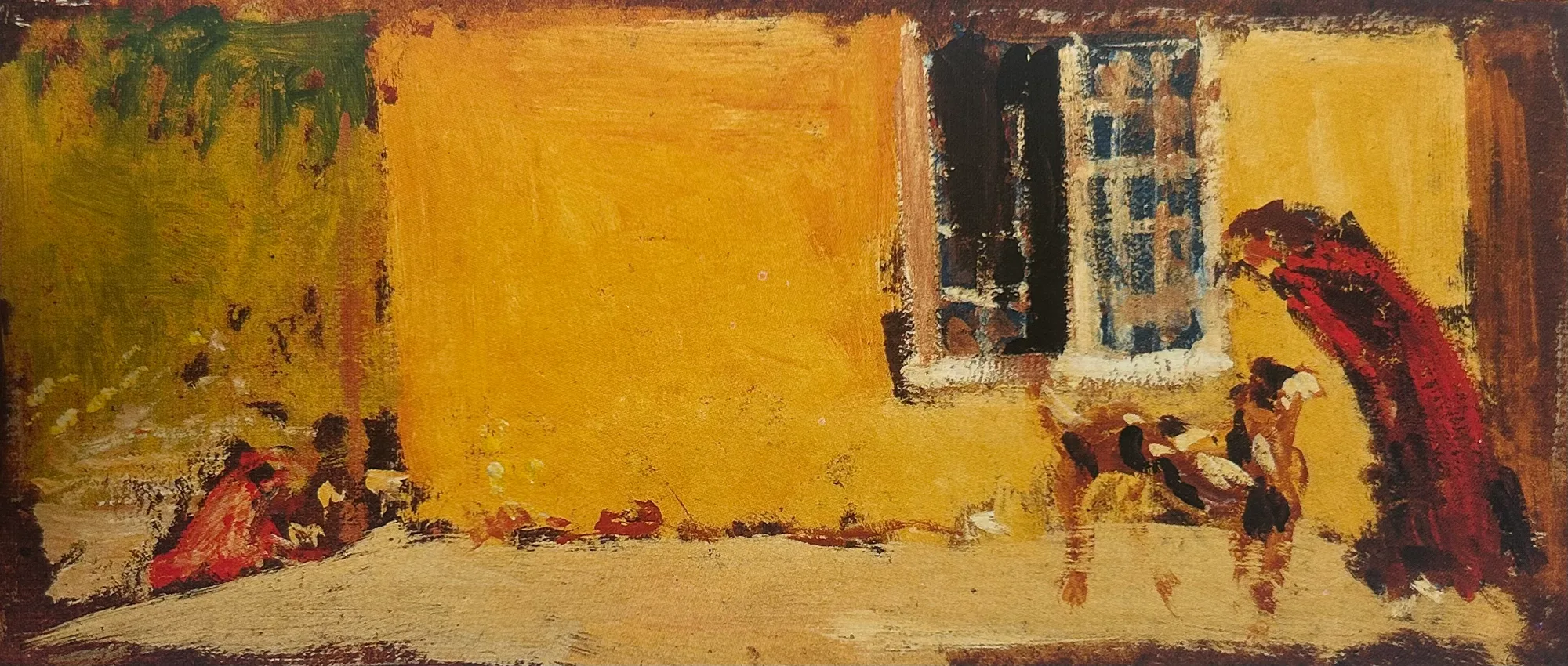
La caresse au chien (étude pour les panneaux Desmarais), 1892
Oil on canvas, 10.5 × 26 cm
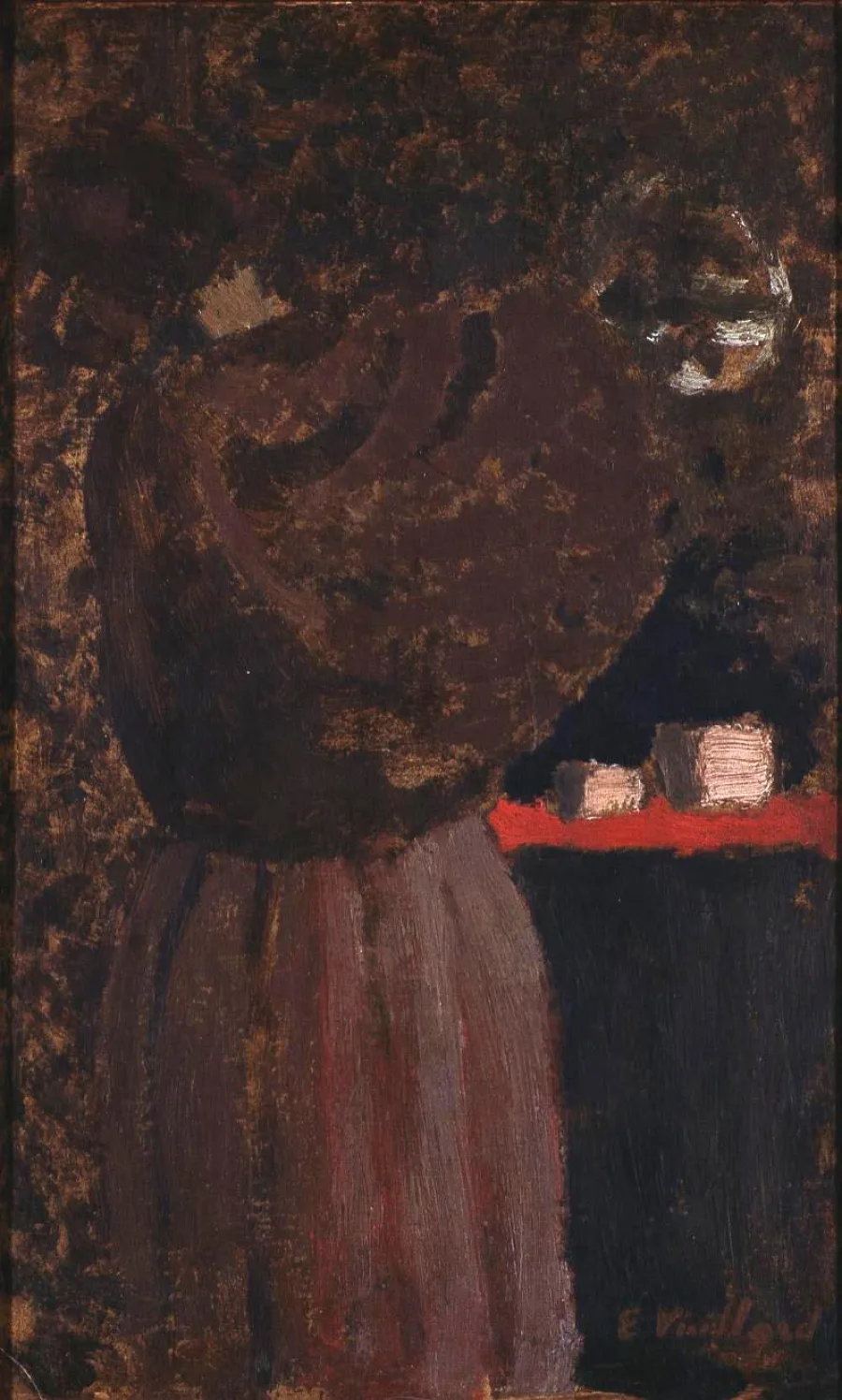
La femme au châle (Misia Natanson), c.1895
Oil on panel, 22.4 × 14 cm, signature stamp lower right
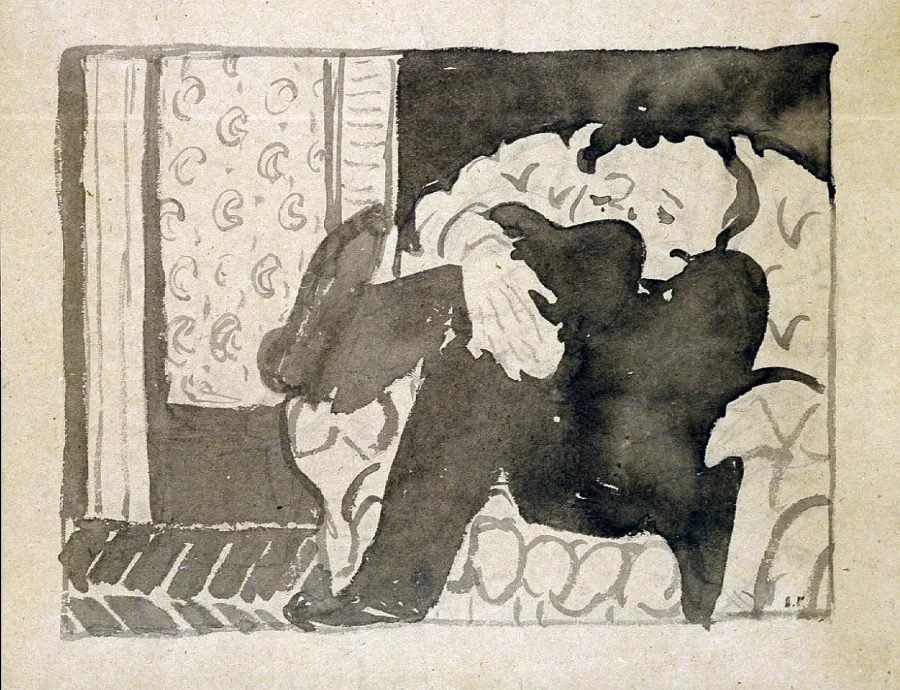
Lugné Poe, c.1892-1893
Indian ink wash, 22 × 28 cm, initials stamp lower right
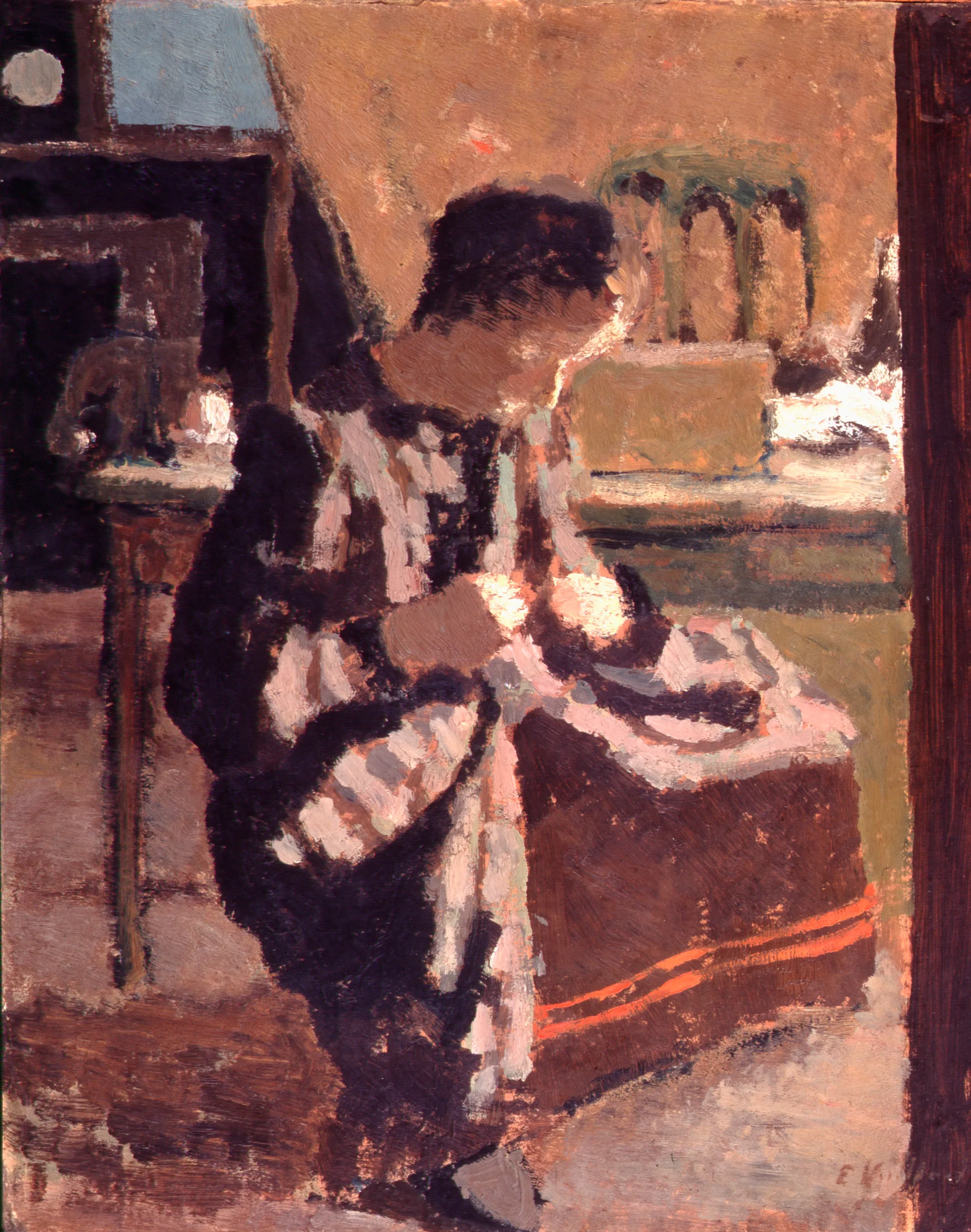
La couture, c.1893
Oil on board, cradled on panel, 26 × 21.9 cm
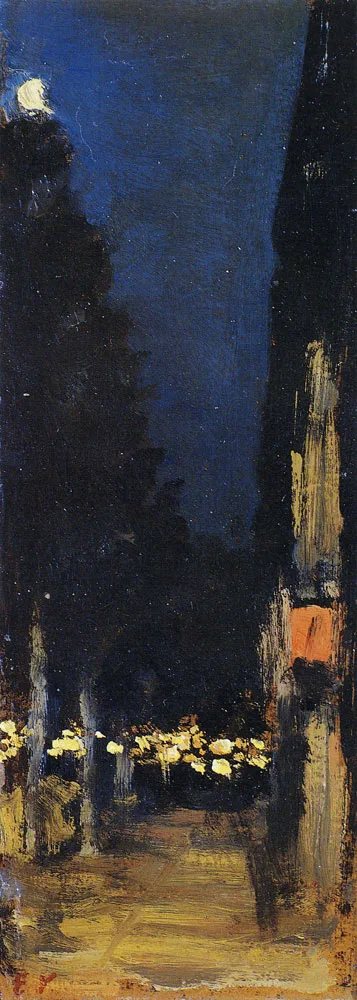
La nuit, c.1895
Oil on board, cradled on panel, 24.4 × 9 cm
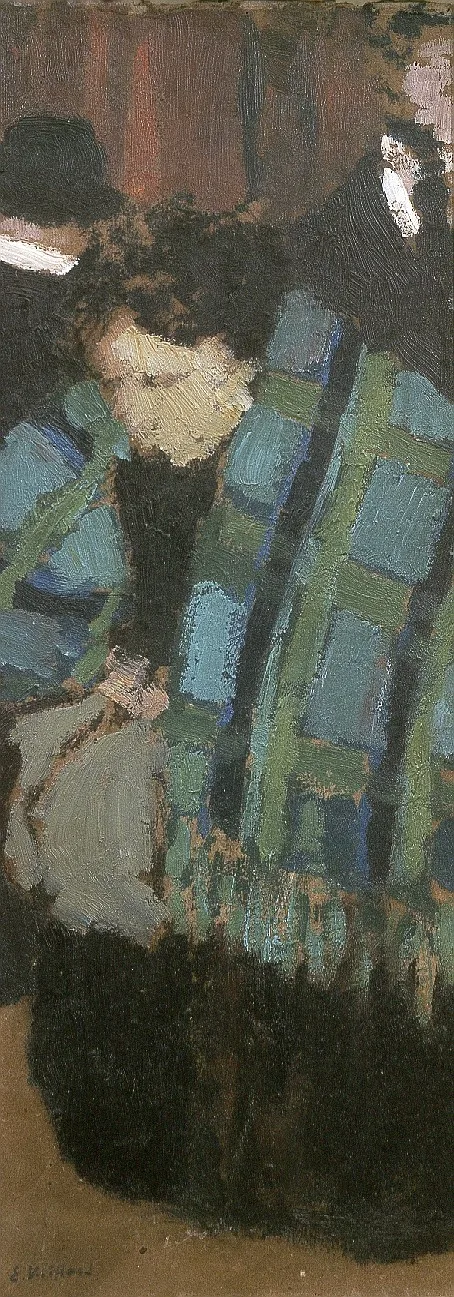
Femme au châle écossais vert, 1895
Oil on board, 31.5 × 12 cm
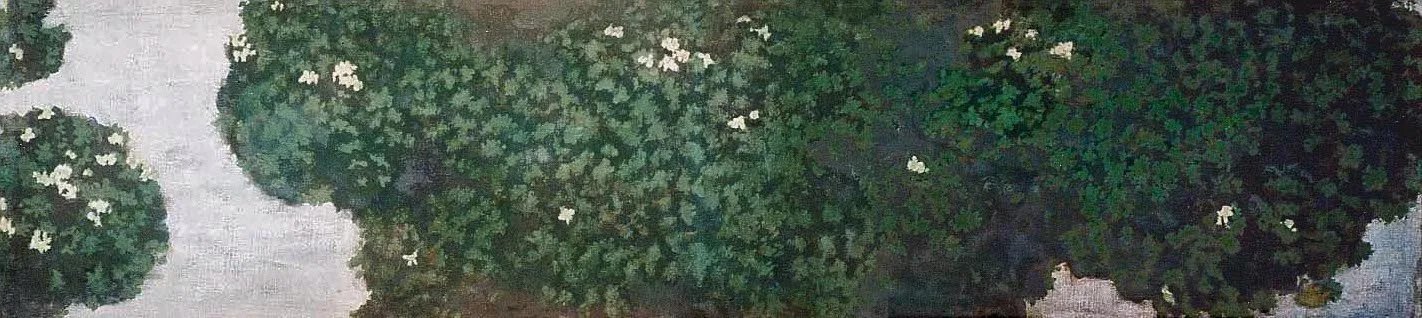
Feuillage (dessus de porte pour les Jardins Publics), 1908
Distemper on canvas, 38.57 × 161 cm
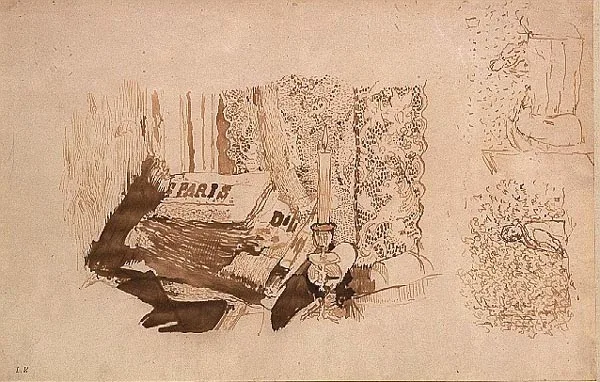
Nature morte au journal (et études), c.1900
Indian ink on paper, 19.5 × 30 cm
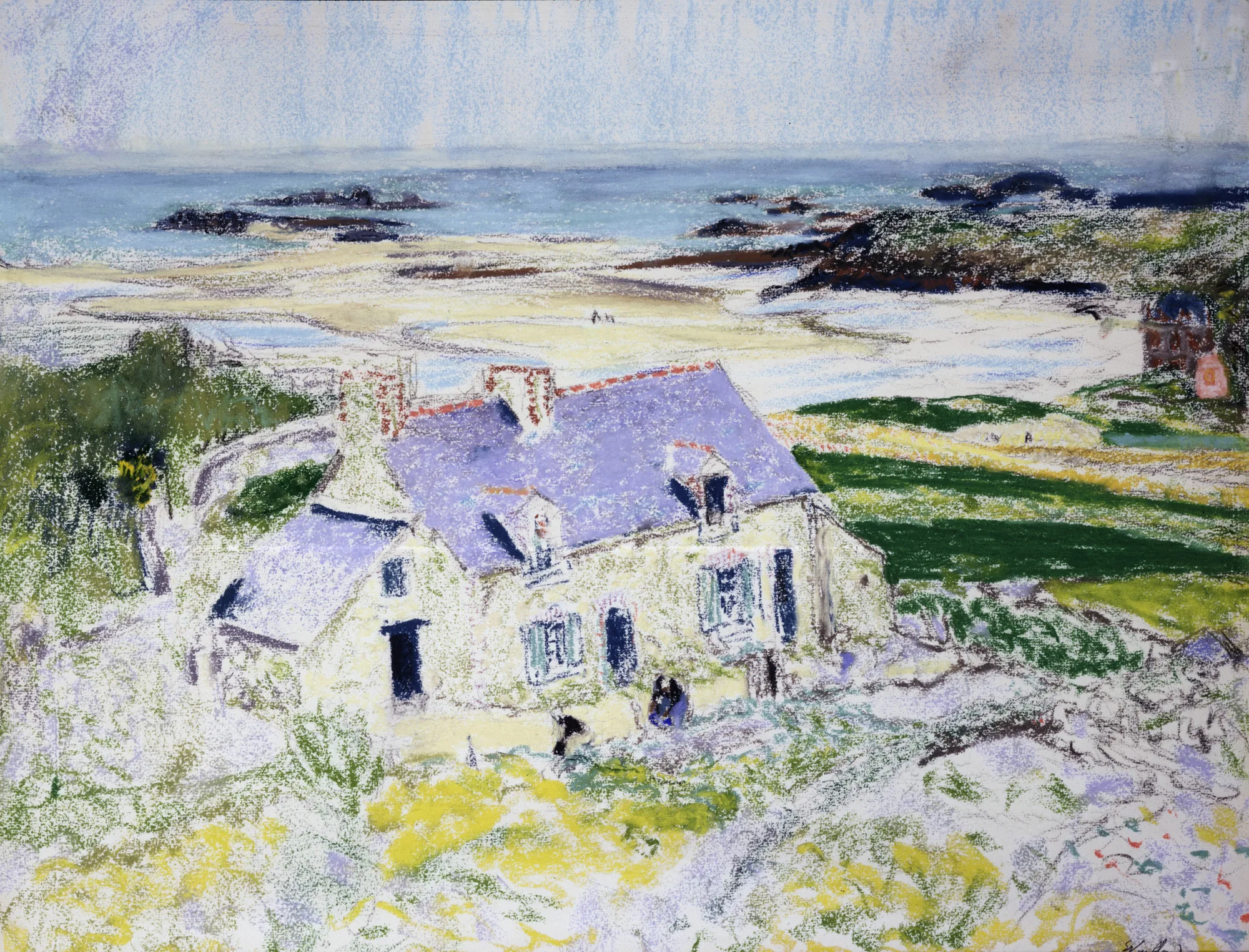
Le toit lilas (Saint-Jacut), 1909
Pastel on paper, 48 × 61 cm
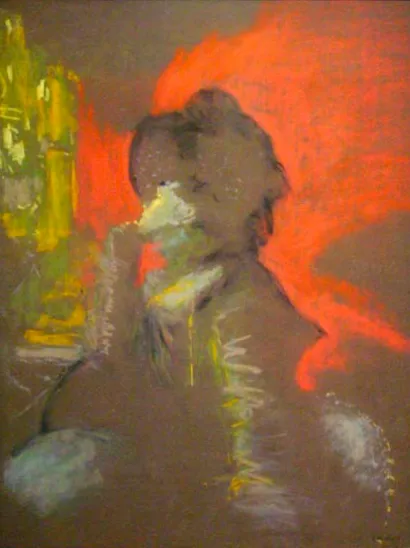
Dans la loge, c.1912
Pastel on paper, 65 × 50 cm
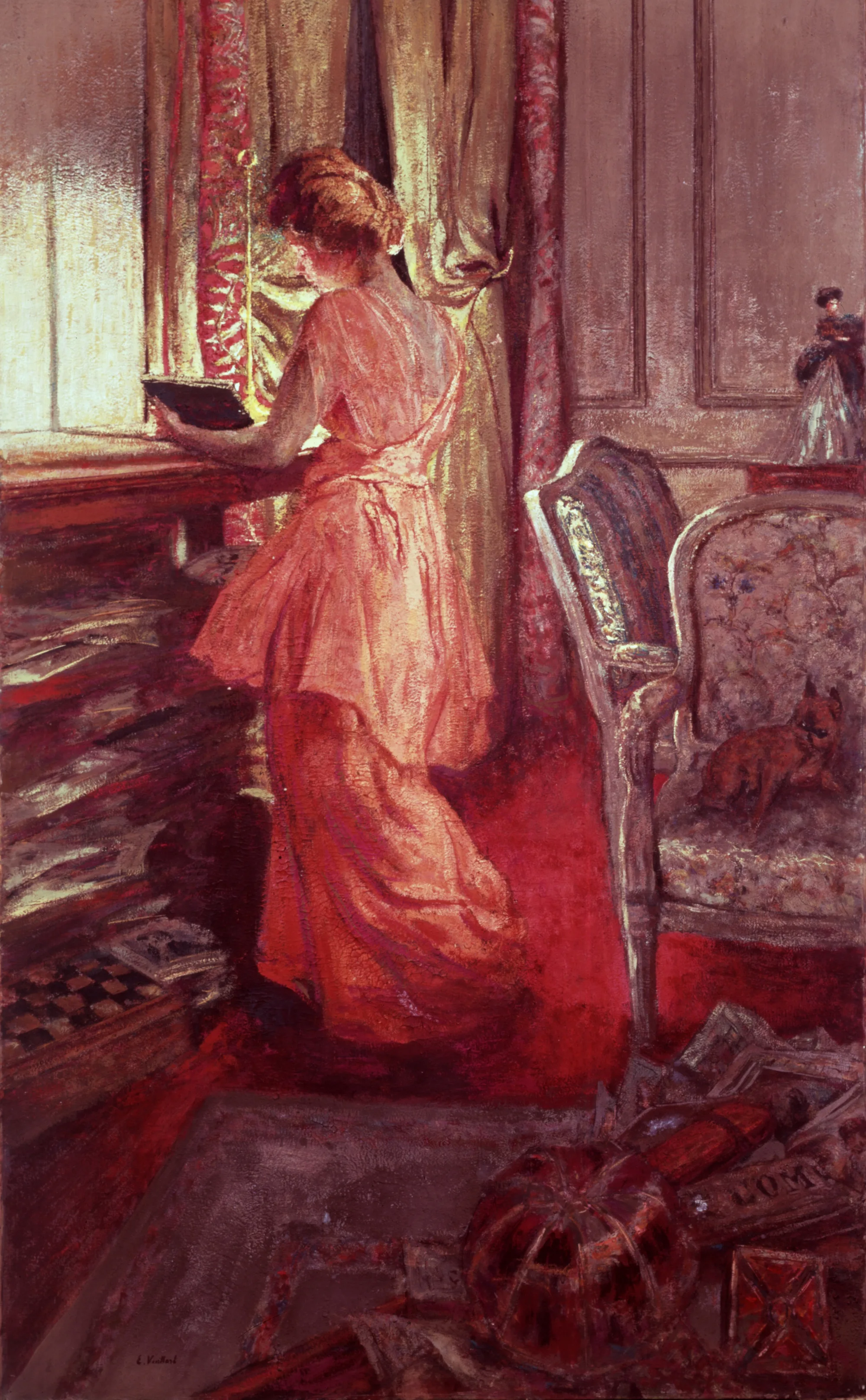
Reine Vaure en robe de soirée, 1914
Reworked several times, 1917, 1926 and 1928, 1933, pastel and glue-based distemper on paper laid down on canvas, 140 × 85 cm
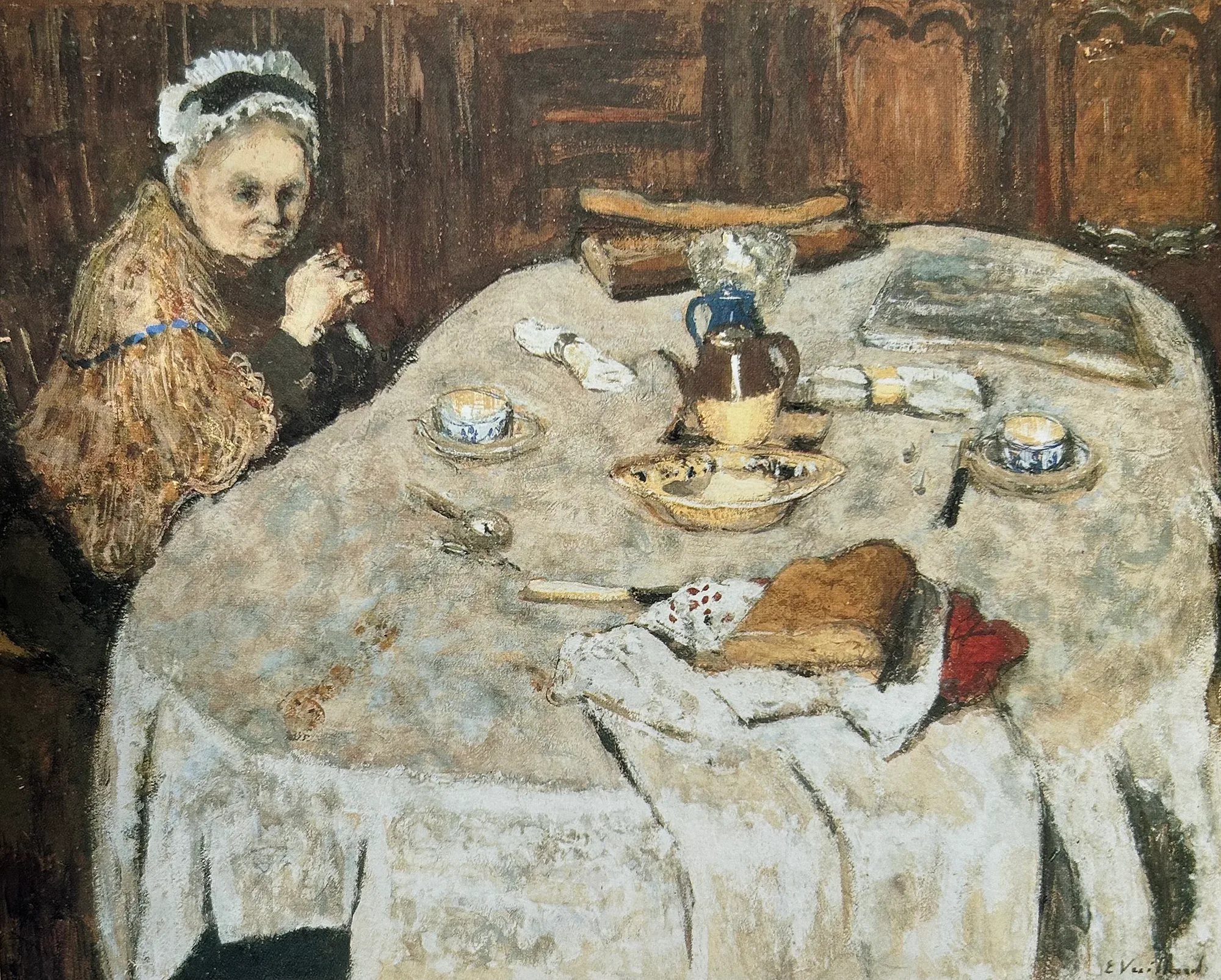
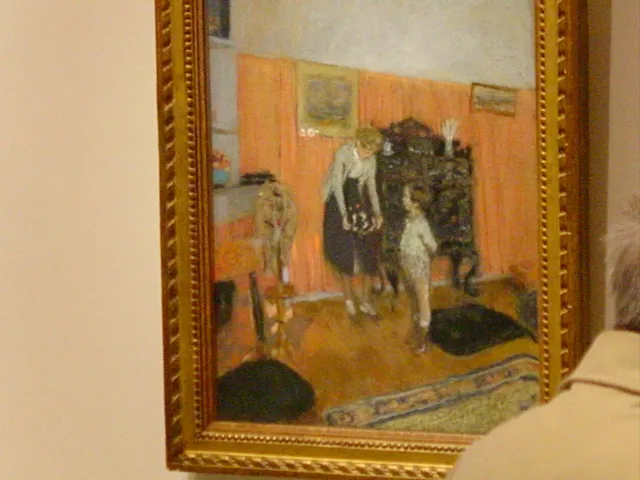
Le Petit-Déjeuner de madame Vuillard, c.1915-1916
Glue-based distemper on board, laid down on a cradled panel, 60.8 × 73.5 cm
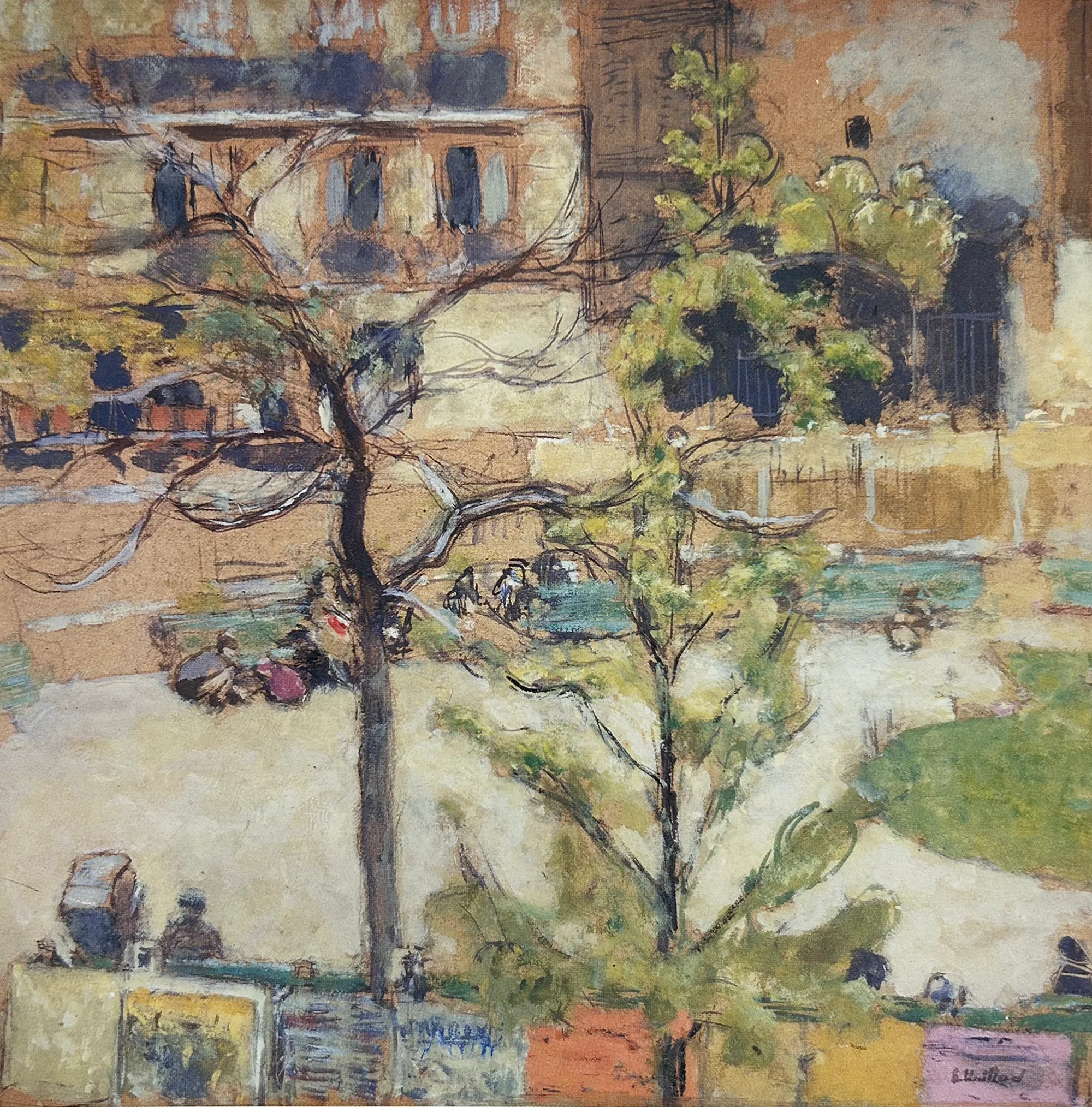
Le Square Berlioz, Place Vintimille, 1919
Glue-based distemper on board, 53 × 53 cm, signed lower right
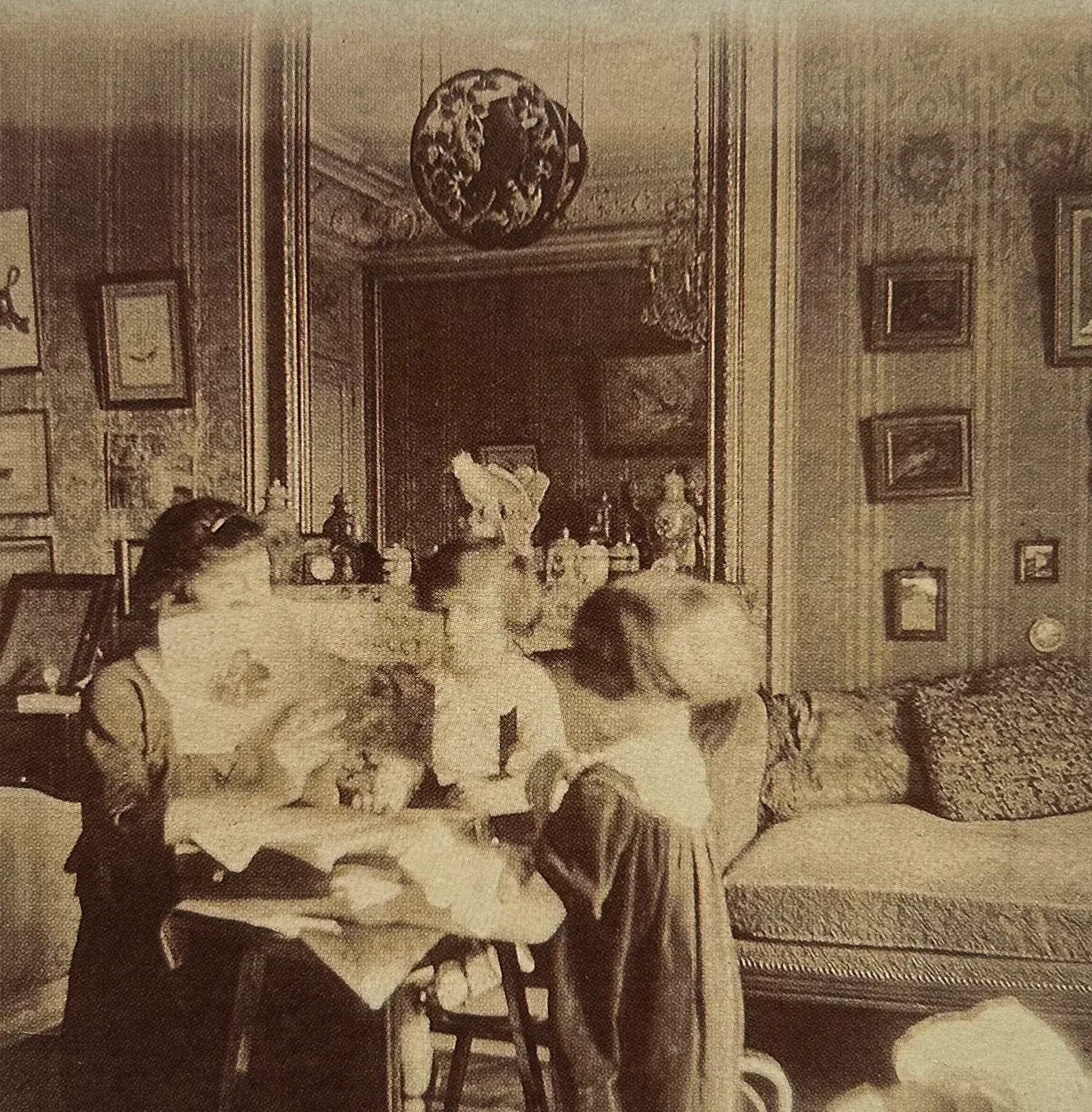
Madame Weil et ses enfants
Photograph by Vuillard
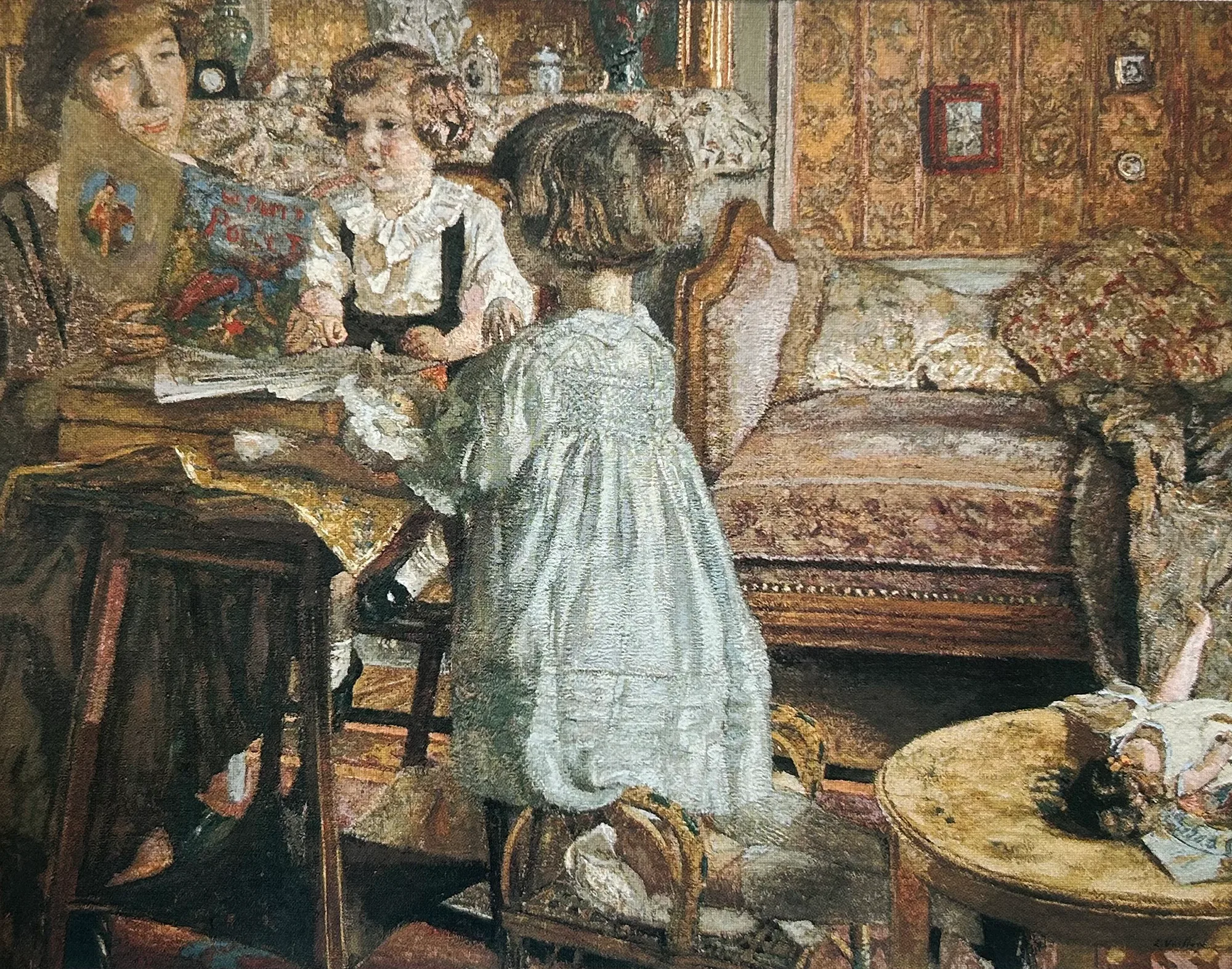
Madame Juliette Weil et ses enfants, 1922
Glue-based distemper on canvas, 103 × 131 cm, signed lower right
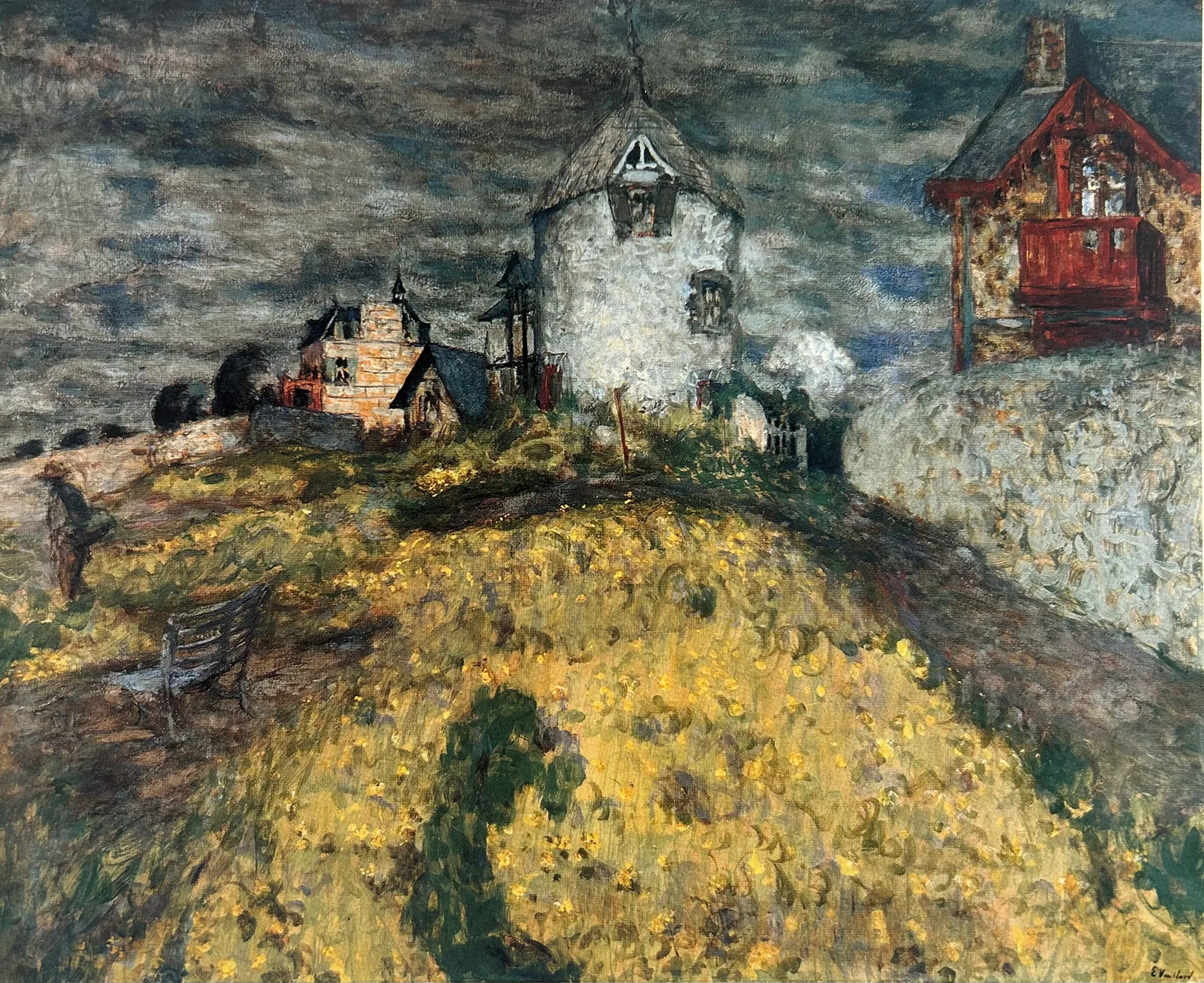
Moulin à Saint-Jacut ou Les Villas, 1909, retravaillé en 1924
Glue-based distemper on canvas, 86 × 107 cm
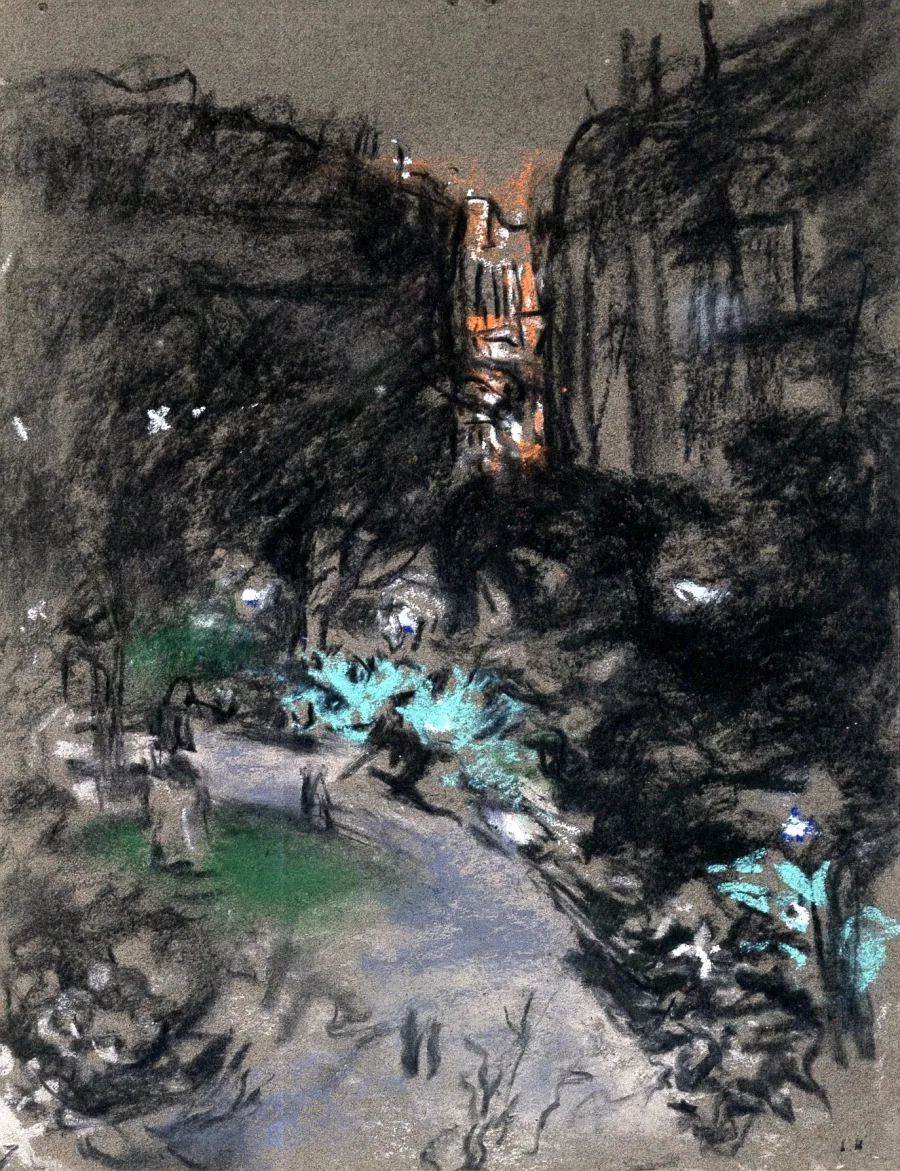
Le square Berlioz, place Vintimille, la nuit, c.1928
Pastel on paper, 32 × 25 cm, initials stamp lower right
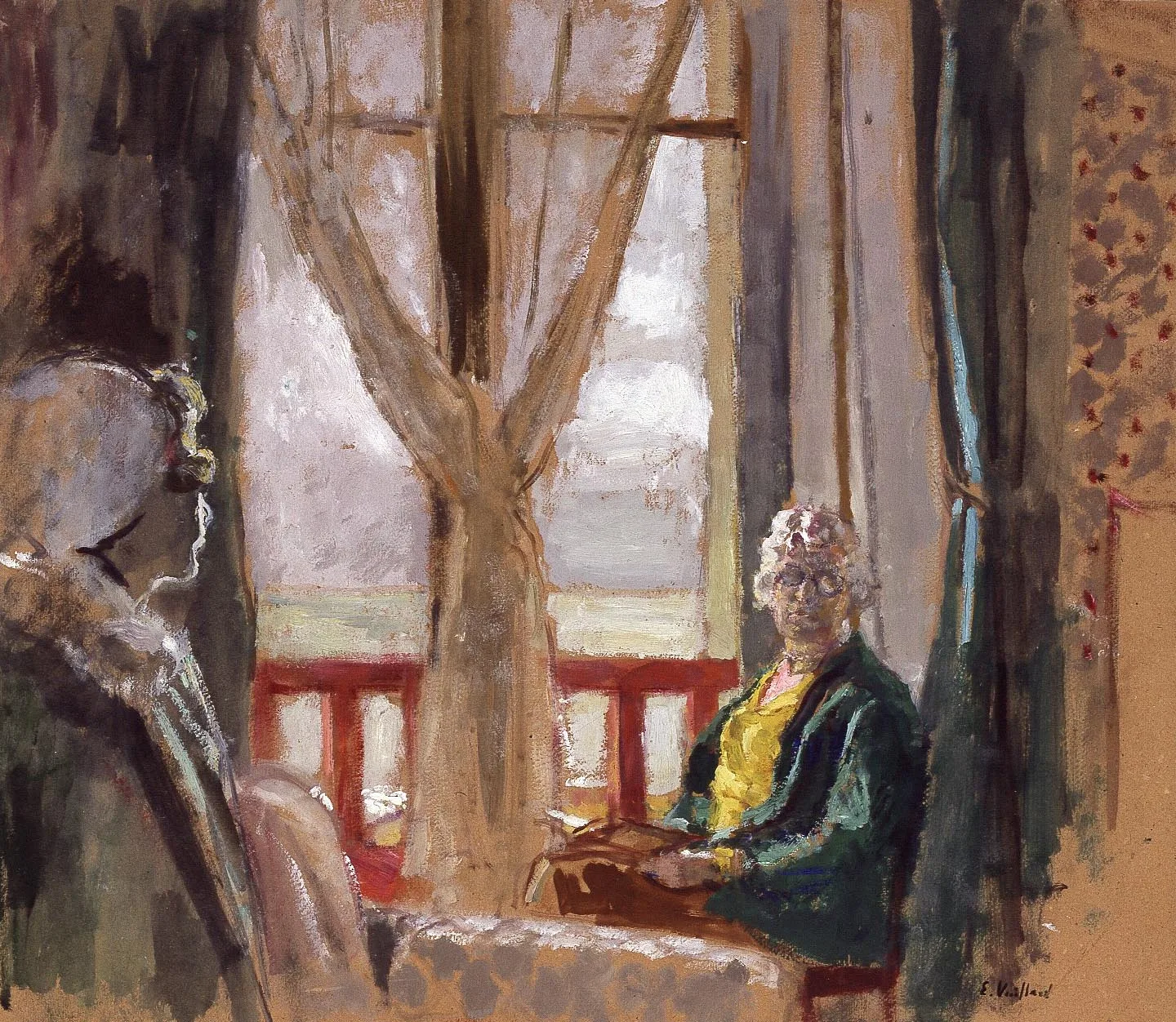
Lucy Hessel et Lulu devant la fenêtre de l’hôtel à La Baule, 1931
Oil on board, 47 × 53 cm
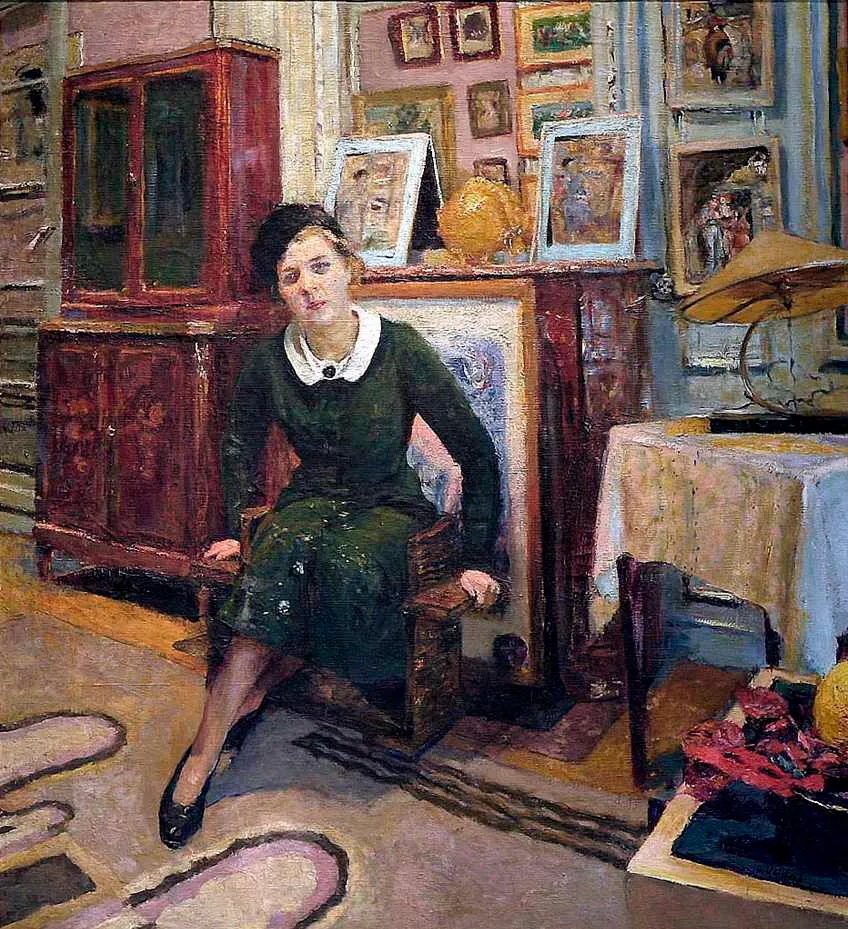
La comtesse Lanskoy, (Chez Marcel Kapferer), 1934-35
Oil on canvas, 88 × 81 cm
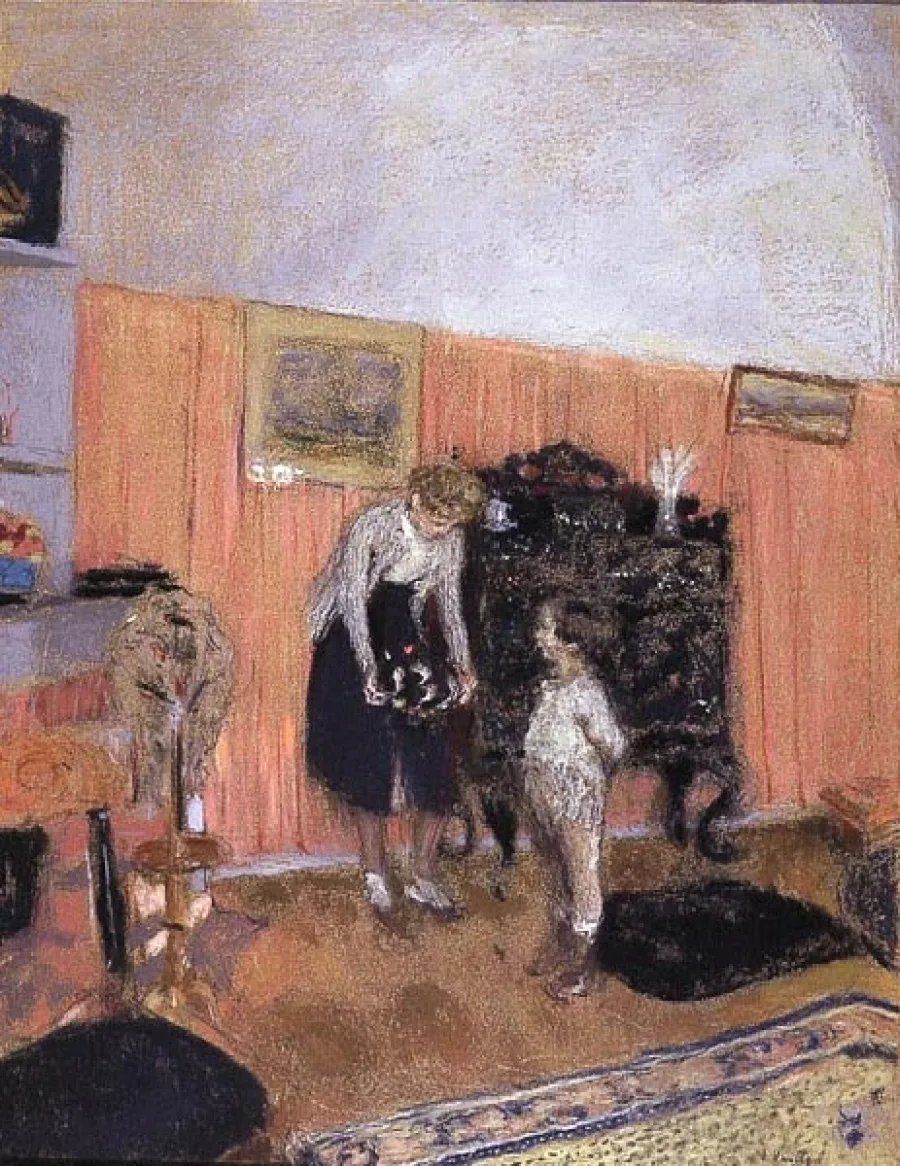
La goëlette, ou Le boudoir rose (Lulu Hessel et Jean-Claude Bellier), 1935
60 × 49 cm, pastel on paper, signed lower right
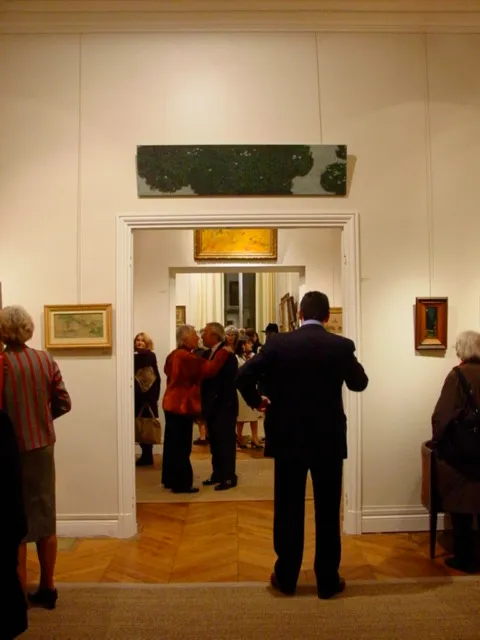
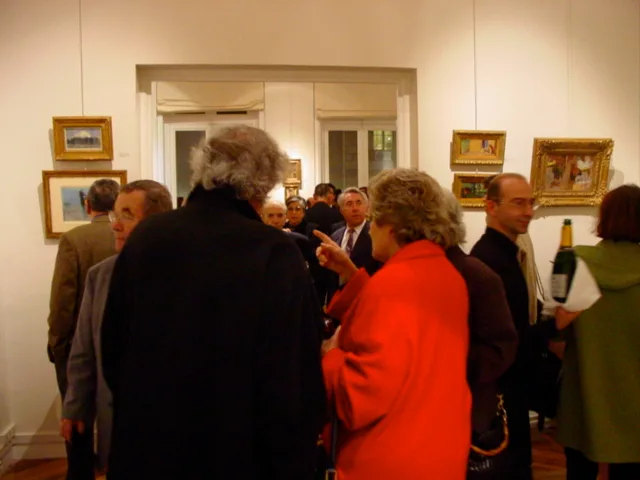
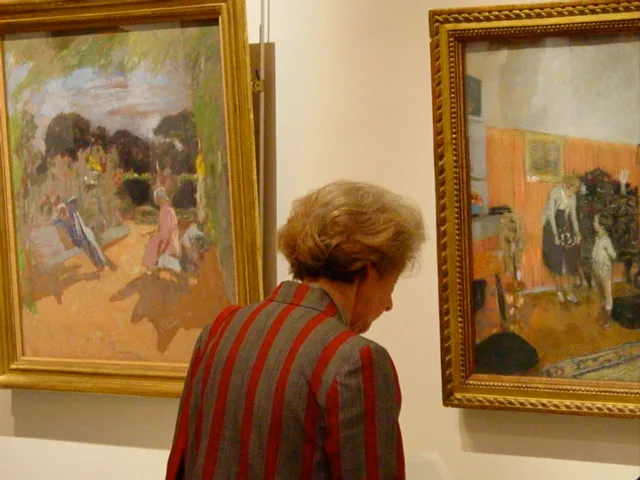
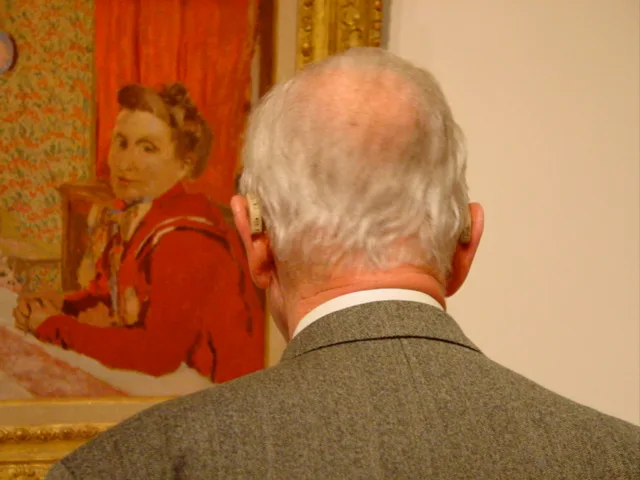
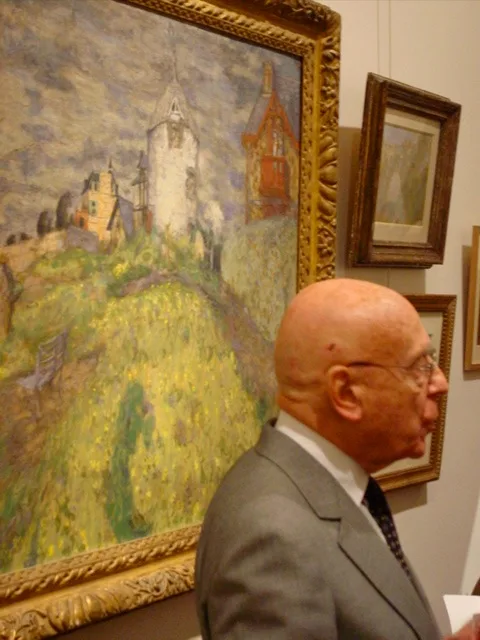
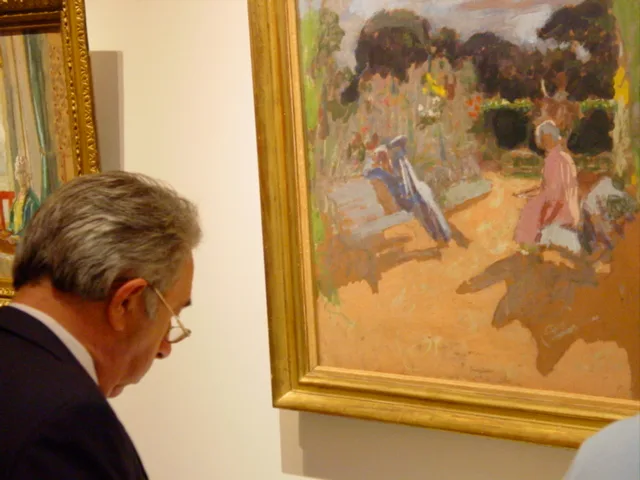
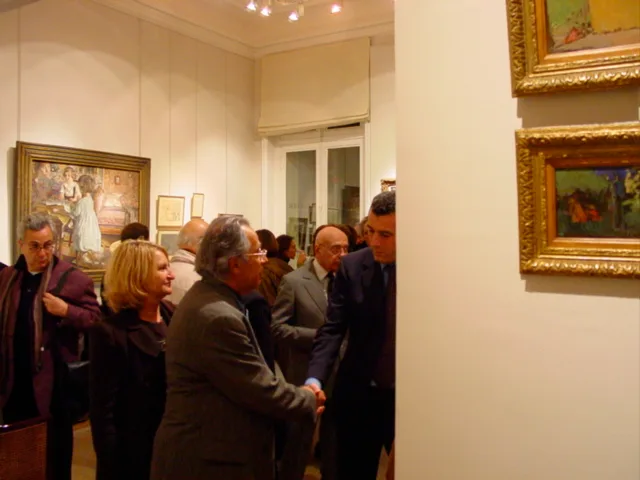
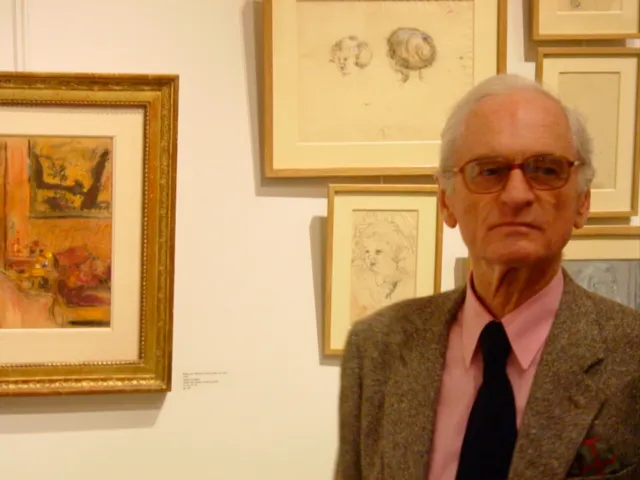
Opening