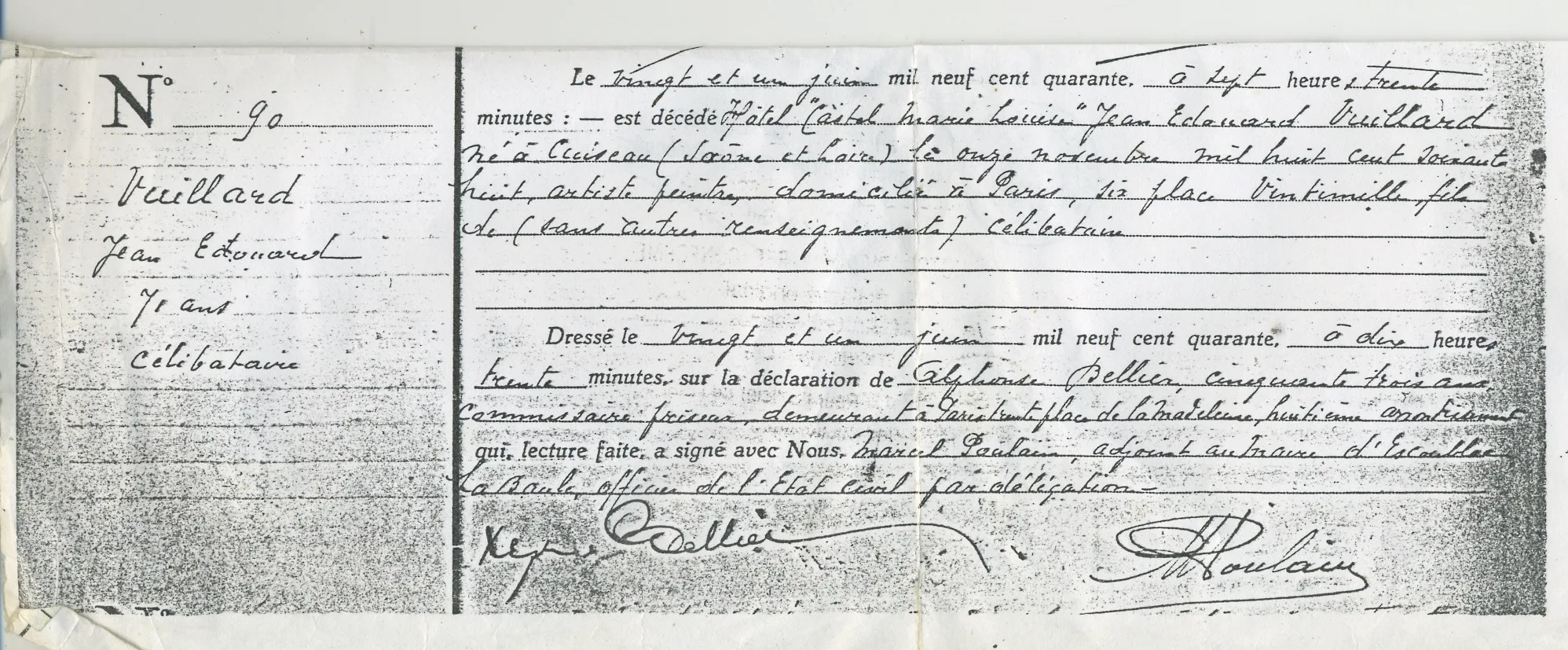
Alphonse Bellier, the King of Auctions
Alphonse Bellier (1886–1980) was the pioneering figure of Parisian auctions who championed “living art”. From his great sales of the interwar years to the delicate judgements of the Occupation, he laid the ethical and artistic foundations of a lineage that became a benchmark on the international market.
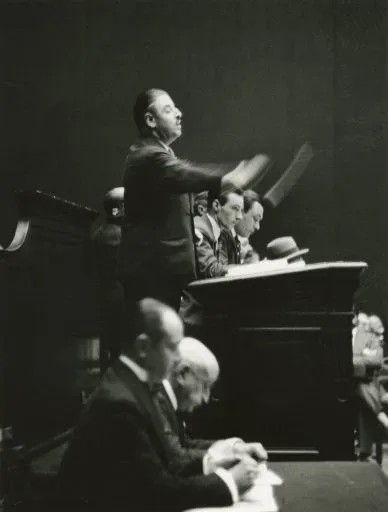
Inventing “Living Art” at Drouot
The history of the Bellier dynasty on the Paris art market officially begins on 27 March 1920, when Alphonse Bellier was appointed auctioneer holding office no. 66 of the Seine. A native of Saint-Nazaire, originally destined for a career as a notary, the thirty-five-year-old immediately brought an unprecedented pace and energy to the heart of the Hôtel Drouot. First setting up his practice on place Boieldieu before settling permanently at 30 place de la Madeleine — the epicentre of the trade in fine curiosities — Bellier established himself as the great architect and champion of what was then called “living art”.
Where the institution favoured classicism, Maître Bellier showcased the daring of the first School of Paris. Understanding before others the need to support the avant-garde, he devised new approaches to public sales: he persuaded artists, collectors and avant-garde figures — such as Raoul Dufy, André Derain and Suzanne Valadon — to submit their works directly to the test of auction. Among his most lasting innovations was the reserve price guaranteed to living artists — an unprecedented commitment for an auctioneer of the time, which protected artists while formally establishing their market value, and which foreshadowed the mechanisms that Christie’s and Sotheby’s would make widespread much later.
Working closely with the leading expert Joseph Hessel, and assisted by Charles Ratton and Robert Lebel — each a guarantor of the authenticity and rigour of the catalogues — he quickly made his mark in the field, so much so that works by Georges Braque and Pablo Picasso naturally found their way into his catalogues from 1924.
Inventing a New Grammar for the Market
In July 1924, Alphonse Bellier, in close collaboration with Léonce Rosenberg, made a founding gesture in the history of the art market: for the first time, he organised a public sale openly associated with the name of its living owner, the great poet Paul Éluard, an enlightened collector whom Bellier persuaded to submit his acquisitions to the test of auction. In doing so, he invented the practice of presenting the collector’s identity as a guarantee of taste, a practice the international market would make standard nearly a century later. André Breton, an accomplice and witness to this quiet revolution, also took part in these exchanges, where the world of ideas and the world of prices became inseparably intertwined.
The following year, in March 1925, Bellier sold the collection of Francis Carco — poet, Montmartre novelist and passionate lover of living painting — and then, in June, that of the dentist and patron Daniel Tzanck, a friend of Duchamp. These two successive sales played a little-known historical role: their results under Bellier’s hammer revealed empirically what the market truly valued, notably the fiery figuration of Modigliani, Soutine and Derain. In November 1925, the sale of the collection of the couturier Paul Poiret — a towering figure of the decorative arts and of French visual modernity — further confirmed the scope of his role. With Bellier, the boundary between the fine arts, the applied arts and fashion became a territory of convergence.
The Great Hours of Modern Painting
Under his inspired hammer came the most memorable sales of the interwar years, founding milestones in the history of modern art. The State first entrusted him with the heavy responsibility of conducting the famous court-ordered sales of Daniel-Henry Kahnweiler’s stock, the largest dispersal of historic Cubist works ever undertaken.
These were followed by the legendary sale of works by Francis Picabia belonging to Marcel Duchamp in 1926, the auction of André Breton and Paul Éluard’s collection of primitive and Surrealist art in 1931, and the exceptional Silberberg sale in 1932 at the Galerie Georges Petit. This sale, which brought together historic works of modern art, confirmed Alphonse Bellier’s ascendancy over prestige auctions and his ability to capture the attention of the greatest private and public collectors in Europe and the United States.
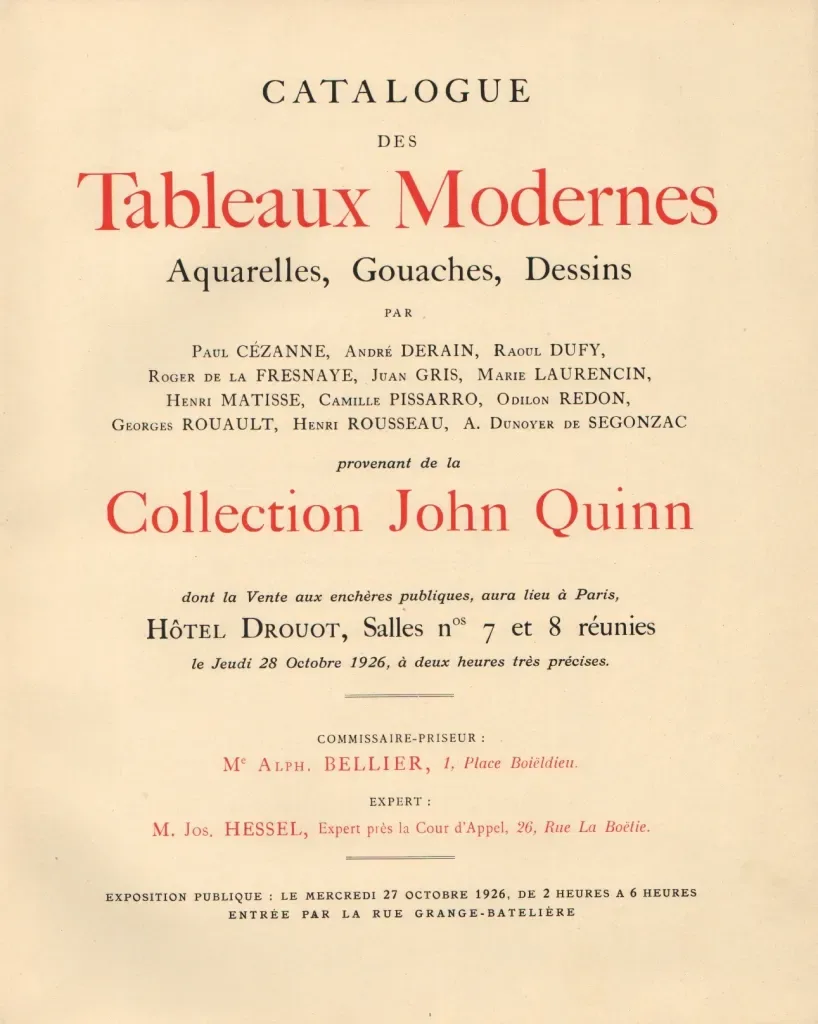
Alphonse Bellier’s international stature was already strikingly apparent in the sale, on 28 October 1926, of the collection of John Quinn — a New York lawyer and visionary patron of modernity, whose firm had defended the interests of the avant-garde from Yeats to Joyce. Quinn was also the donor of the only major Seurat in the French national collections. Held at the Hôtel Drouot under Bellier’s hammer, the sale brought together major canvases by Cézanne, Matisse, Derain, Rouault, Rousseau and Juan Gris, introduced by Jean Cocteau. It was one of the first great Paris public sales of an American collection devoted entirely to living art. That same year, Christian Zervos had founded the journal Cahiers d’Art — a theoretical and critical echo of what Bellier was achieving on the market — and the auctioneer had close affinities with this circle, which would notably lead to the resale of the journal’s stock.
In the same spirit came two complementary sales in 1931 and 1932, which reflect the breadth of his networks and his ability to bring together the avant-garde and primitive art. In December 1931, at the Hôtel Drouot, he sold the collection of Georges de Miré — a singular group of early sculptures from Africa and the Americas, and a barometer of the Surrealists’ enthusiasm for non-Western art. A few months later, in December 1932, at the Galerie Georges Petit, he conducted the sale of the Jules Strauss collection: this enlightened Frankfurt banker had patiently assembled a first-rate collection, from Delacroix to the Impressionists, and the 1932 sale — crowning a first collection already sold at Drouot in 1902 — established Bellier as the undisputed arbiter of the great estates of the French School. Finally, in 1938, at the Galerie Charpentier, he conducted the sale of the collection of the Duc de Trévise, with Paul Rosenberg and Robert Lebel as experts, confirming the lasting loyalty of aristocratic collectors to Maître Bellier’s services.
The Occupation and the Safeguarding of Léonce Rosenberg’s Stock
During the dark years of the Occupation, the firm’s activity was sustained by a paradoxically euphoric art market. Between 1941 and 1944, Maître Bellier conducted more than 250 sales. As a ministerial officer subject to the drastic regulations issued by the supervising authorities, he faced the legal demands imposed by the circumstances of the time and complex estates — such as the highly publicised posthumous sale of Dr Georges Viau in 1942, not to mention the four sales of the collections of the incomparable Félix Fénéon.
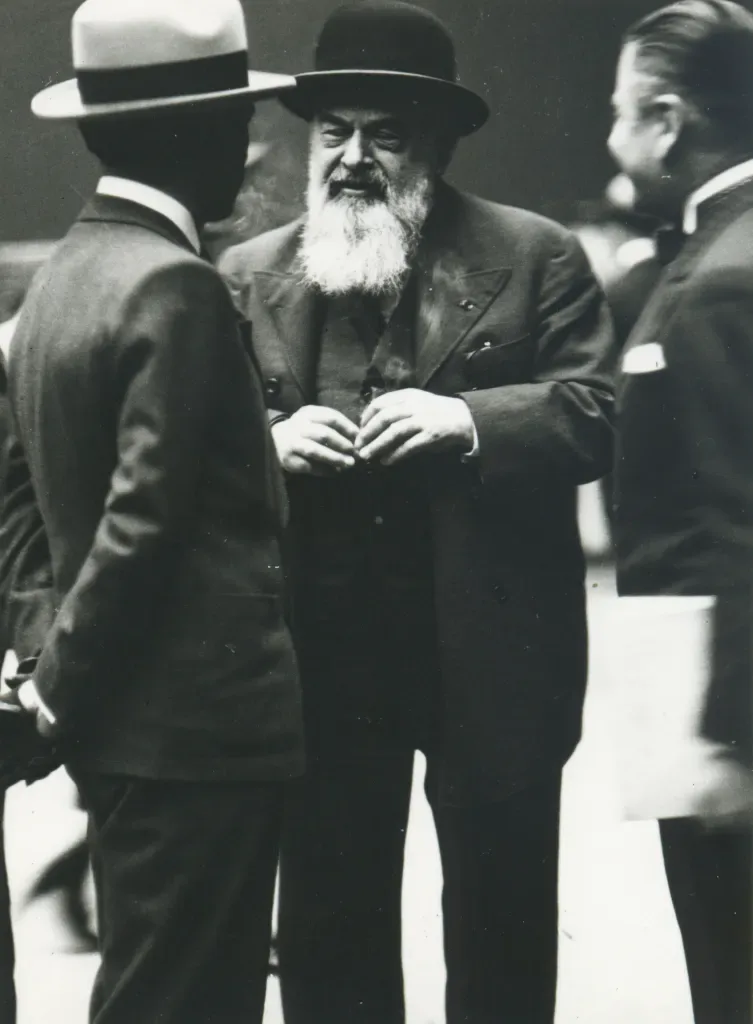
In this extremely sensitive context, Bellier strove to protect what could be protected, putting his skill as a negotiator at the service of friends. As early as April 1941, before the introduction of the despoiling provisional administrations, he concluded a secret, life-saving agreement with his friend Léonce Rosenberg, anonymously taking charge of 41 works from his stock in order to sell them in separate lots and thus protect the dealer’s interests.
The Liberation and the Gabriel Cognacq Collection
At the Liberation, Bellier’s integrity and standing remained intact. Recognised by his peers and cleared of any sanction, he immediately placed his firm’s archives and expertise at the service of the families and gallery owners who had been victims of looting, helping them to document and recover their dispersed property. He thus worked actively alongside the Jacob gallery and the Bernheim-Dauberville brothers, himself initiating enquiries with buyers in order to have wartime sales annulled and the works returned to their rightful owners.
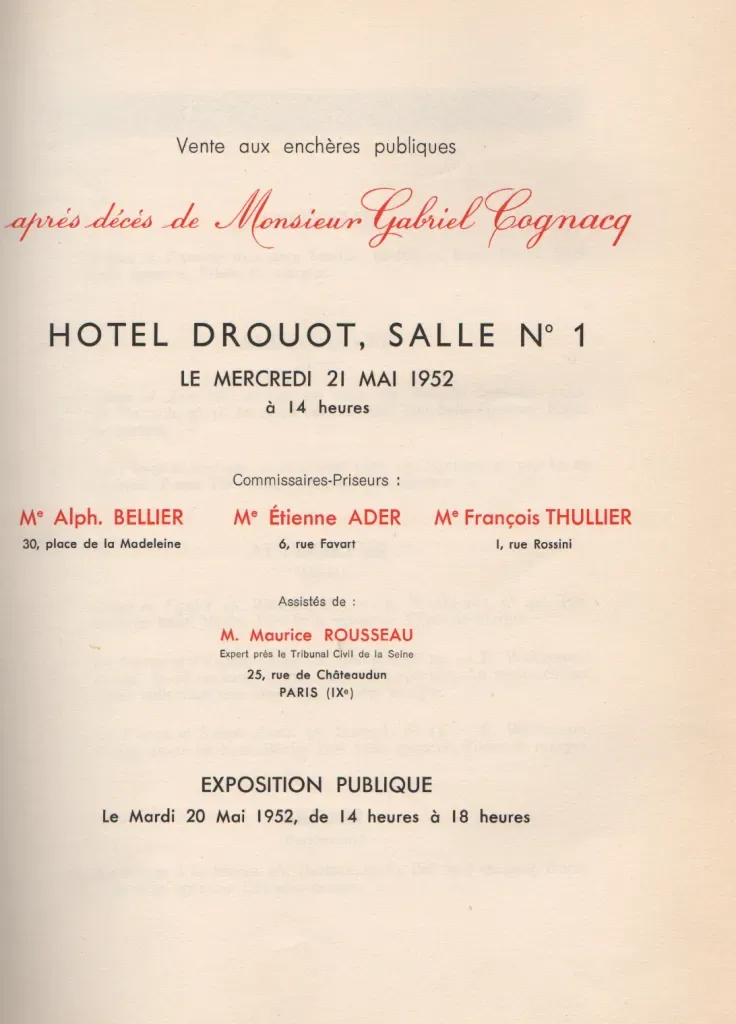
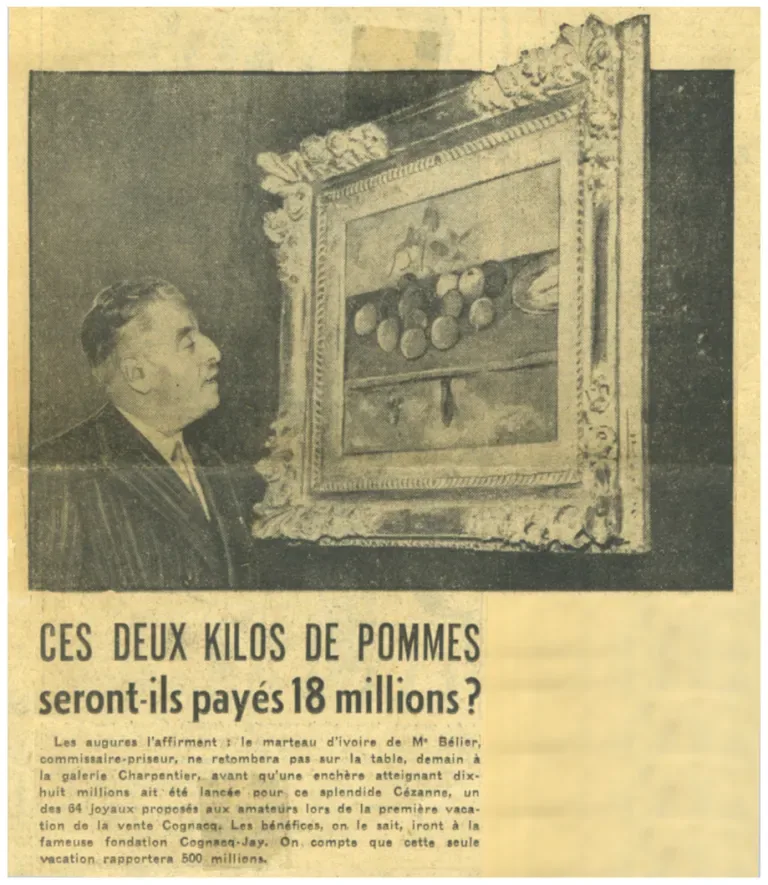
The reach of his influence was also evident in the sale of the Gabriel Cognacq collection in 1952. At the Galerie Charpentier, under the gaze of the international press, Alphonse Bellier conducted a historic sale. This series of sales, whose proceeds were donated in full to the Fondation Cognacq-Jay, confirmed his role as undisputed arbiter. And as the crowning finale of his career came the Regnault sale in Amsterdam, with works by Picasso, Kandinsky and Modigliani, which he conducted on 22 and 23 October 1958 and which was, for the first time, broadcast on Dutch television. Among the buyers, the figure of Ernst Beyeler was already standing out.
The most moving testimony to the deep dignity and trust he inspired lies, no doubt, in the last wishes of Georges Lévy. Arrested and held at Drancy in October 1943 before his deportation to Auschwitz, this great collector explicitly chose Maître Bellier in his will to conduct the posthumous sale of his collection. Faithfully carried out in 1947 and 1950, these prestige sales made it possible, in accordance with the deceased’s wishes and under the aegis of Chief Rabbi Kaplan, to donate all the proceeds to Jewish families afflicted by the war. When he handed over his office in 1958 after thirty-eight years of continuous practice, Alphonse Bellier left behind him an ethics of the eye and a name inseparable from the history of modern art.
An Eye, a Lineage
The depth of this legacy can perhaps be measured most keenly in the figure of his son, Jean-Claude Bellier — godson of Édouard Vuillard, whose bond with the Bellier family was one of very deep friendship. Ker-Xavier Roussel, Vuillard’s brother-in-law and himself a leading Nabi painter, had chosen Renée Deville — Jean-Claude’s mother and Alphonse’s wife, an opera singer and the daughter of a famous tenor — as the executor of his will: proof that the Bellier firm was a place of trust where artists entrusted their final view of their own work. It was in this environment of intimate closeness with the great figures of the century that Luc Bellier was able to benefit so preciously from a knowledge of the world of the past.